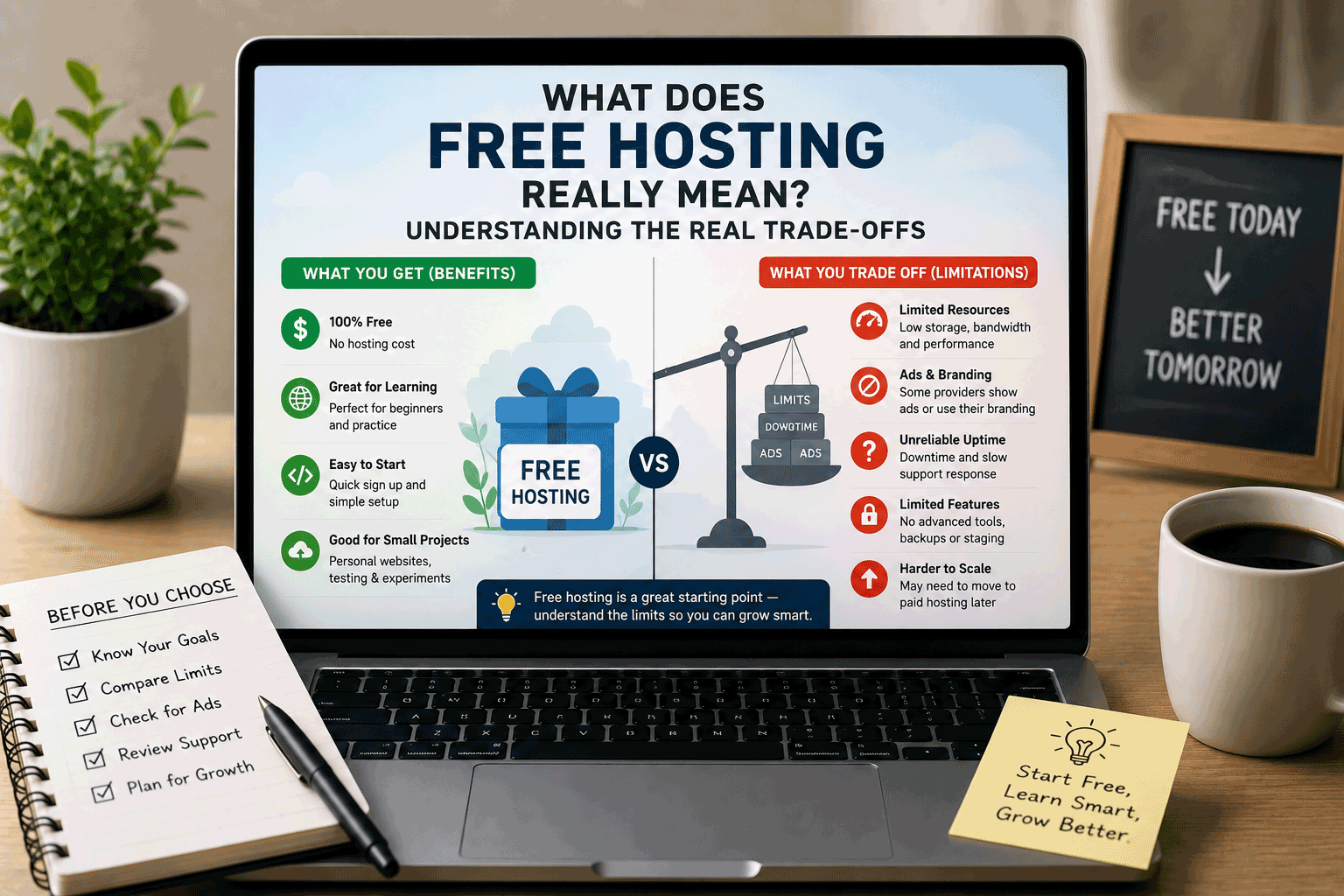
Free hosting sounds simple.
You want to build a website, you find a provider that offers free hosting, and you publish your website without paying for a hosting plan. For beginners, students, creators, small project owners, and people testing ideas, this can be very attractive.
And in many situations, free hosting can be genuinely useful.
It can help you learn how websites work. It can give you a place to test a project. It can support a small portfolio, a simple landing page, a school assignment, a practice WordPress site, or a temporary website before you decide what to do next.
But the word “free” can also create confusion.
Free hosting does not usually mean unlimited freedom, unlimited resources, or a perfect long-term solution for every website. It means the provider is allowing you to use a hosting service without paying directly for that plan, usually with certain limits, trade-offs, or upgrade options.
That is not necessarily a bad thing.
The important point is to understand what you are really getting — and what you may be giving up in return.
Free hosting is free to start, but not free from limits
When a hosting provider offers a free plan, it still has costs behind the scenes.
Servers cost money. Storage costs money. Bandwidth costs money. Security, maintenance, software, infrastructure, and support all require resources. Even if you are not paying for the free plan, the provider still needs a way to keep the service running.
This is why most free hosting plans come with limitations.
Those limits may be related to storage, bandwidth, website speed, support, custom domains, backups, databases, email, file types, or advanced features. Some providers may show ads or branding on free websites. Others may offer no ads, but limit resources and encourage users to upgrade later.
In other words, free hosting usually gives you a starting point, not everything a paid hosting plan would provide.
That is perfectly reasonable, as long as you know the trade-offs before you begin.
The real meaning of “free” depends on the provider
Not all free hosting services work the same way.
Some providers offer free hosting as a way to introduce users to their paid plans. Some use free plans to support beginners and students. Some provide free static hosting for developers and open web projects. Some include free hosting inside website builders. Some allow free use but place branding or ads on the website.
Because of this, the word “free” can mean different things depending on the platform.
It may mean:
- free with limited storage
- free with limited bandwidth
- free with provider branding
- free with ads
- free with a provider subdomain
- free for static websites only
- free for personal projects only
- free with upgrade options
- free with limited support
- free with usage restrictions
So when you see “free hosting,” it is important to look beyond the headline.
The better question is not only:
“Is it free?”
The better question is:
“What are the conditions of the free plan?”
Free hosting is often designed as a starting point
Free hosting is usually best understood as an entry-level option.
It helps people start without needing to pay first. This is useful because many people are not ready to choose a paid hosting plan on day one.
A beginner may not yet know whether they need WordPress, static hosting, a website builder, PHP, MySQL, or a developer platform. A student may only need to publish a class project. A small business owner may want to prepare a draft website. A creator may want to test a simple idea.
In these situations, free hosting can make sense.
It gives users a chance to try, learn, and understand their needs before spending money.
But because free hosting is often a starting point, it may not always be the best final home for a growing or serious website.
That is the trade-off.
The provider may expect you to upgrade later
Many free hosting services are built around a freemium model.
This means the provider gives users a free plan with basic features, while offering paid plans with more resources, better performance, custom domains, no ads, backups, support, or advanced tools.
This model can be fair and useful.
You can start free, test the platform, and upgrade only if your website becomes more important.
But beginners should still check the upgrade path before choosing the free plan.
If the free plan is too limited and the paid plan is too expensive, you may feel stuck later. If upgrading does not remove the limitation that matters to you, then the free plan may not be a good starting point.
A good free hosting plan should give you a clear and reasonable next step.
Ads and branding are common trade-offs
Some free hosting providers display ads or branding on user websites.
This is one way they support the cost of offering free service.
For a practice website, this may not be a major issue. If you are only testing a layout, learning HTML, or preparing a temporary project, ads may be acceptable.
But for public websites, ads and branding can affect trust.
A portfolio with unrelated ads may look less professional. A small business website with provider banners may feel less credible. A landing page with popups may distract visitors from the main message.
This is why ads and branding should be checked carefully.
A free plan with ads may still be useful, but it may not be suitable for every purpose.
Storage limits can affect growth
Storage is the space your website uses for files, images, themes, plugins, documents, backups, and media.
Free hosting often includes limited storage.
At the beginning, this may feel fine. A small website with a few pages and images may not need much space. But as the website grows, storage can become a real limit.
This is especially true for WordPress sites, blogs, portfolios with many images, or websites that upload downloadable files.
When storage runs out, you may need to delete content, reduce image size, upgrade the plan, or move to another host.
That is why “free” should not be judged only by whether the site can be published today. You should also think about whether the plan can support the content you may add later.
Bandwidth limits can affect visitors
Bandwidth is related to how much data your website can send to visitors.
If your site has many visitors, large images, downloads, or heavy pages, it may use more bandwidth. Some free hosting providers limit monthly bandwidth. If you exceed the limit, your website may slow down, stop loading, or require an upgrade.
For a private test site, bandwidth may not matter much.
For a public website, it can matter quickly.
If you plan to share your website on social media, send it to customers, use it in a portfolio, or publish content for readers, bandwidth should be checked.
A free plan may be enough for small traffic, but not always for a growing audience.
Website speed may not be the same as paid hosting
Free hosting may use shared resources.
This means many websites may run on the same infrastructure, and each site may have limited access to server power. As a result, free websites may load slower or feel less consistent than websites on paid hosting.
This does not mean every free host is slow. Some free hosting options, especially certain static hosting platforms, can be fast for the right type of website.
But performance should never be assumed.
For learning and testing, speed may not be your biggest concern. For a business website, portfolio, landing page, or blog, speed becomes more important because it affects visitor experience.
A slow website can make visitors leave before they even read your content.
Support is often limited on free plans
Support is another common trade-off.
Paid hosting plans usually come with better support options. Free plans may rely on documentation, community forums, knowledge bases, or limited ticket support.
This may be acceptable if you are learning and comfortable solving problems yourself.
But if your website is important, limited support can become stressful.
If the site goes down, a contact form stops working, a WordPress issue appears, or DNS settings become confusing, you may want direct help. On many free plans, that help may be limited or slower.
This is one reason free hosting is better for low-risk projects than mission-critical websites.
Backups may not be included
Backups are easy to forget until something goes wrong.
A website can break because of a mistake, update issue, file deletion, plugin conflict, account problem, or security incident. If you have a backup, recovery is easier. If not, you may lose hours or weeks of work.
Some free hosting plans do not include automatic backups. Some provide backups only on paid plans. Some allow manual backups, but the user must handle the process.
This is an important trade-off.
Even if your hosting is free, your content and time are not free.
If you are building anything valuable, check backup options before relying on a free platform.
Custom domains may require a paid plan
Many free hosting services provide a free subdomain, such as:
yourname.provider.com
This can be fine for testing or learning.
But if you want a more professional website, you may want your own domain, such as:
yourname.comyourbrand.comyourproject.com
Custom domain support is not always included in free plans. Some providers allow it. Some require a paid upgrade. Some website builders reserve custom domains for premium plans.
This matters because a custom domain gives your website a cleaner identity and more long-term control.
If you plan to build a public website, portfolio, business page, or blog, custom domain support should be checked early.
Email hosting may not be included
Another detail beginners often miss is email.
Having a website does not always mean you automatically get email addresses like:
contact@yourdomain.com
Free hosting plans often do not include email hosting. Some may offer email forwarding. Some may require a paid plan. Others may not provide email features at all.
For a student project, this may not matter.
For a business, freelancer, organization, or professional website, email can be important.
If you need domain-based email, check whether the hosting provider includes it or whether you need a separate email service.
Free hosting may have usage rules
Free hosting providers usually have rules to prevent abuse.
These rules may limit certain activities, file types, scripts, email sending, resource usage, adult content, commercial use, cron jobs, or high-traffic behavior. Some providers may suspend inactive accounts. Others may remove websites that violate their terms.
Most normal users will not have problems if they follow the rules.
But it is still worth reading the basic conditions before building your website.
A free plan is not the same as unlimited control. It comes with a service boundary, and users should know where that boundary is.
Migration may become the hidden cost
One of the biggest hidden trade-offs of free hosting is migration.
At the beginning, you may not think about moving. You only want to publish the site. But later, your website may grow. You may want better performance, more storage, a custom domain, no ads, stronger support, or a paid hosting plan.
If migration is easy, this is not a big problem.
If migration is difficult, the free platform can become limiting.
For static websites, moving may be simple if you can download your files. For WordPress, you need access to files and the database. For website builders, exporting the full site may be difficult or impossible depending on the platform.
This is why free hosting can sometimes cost you time later, even if it saves money today.
Free hosting can cost time, attention, or flexibility
The cost of free hosting is not always money.
Sometimes the cost is:
- time spent dealing with limitations
- reduced control over the website
- forced ads or branding
- weaker performance
- limited support
- difficulty moving later
- lack of backups
- fewer features
- less professional appearance
- uncertainty about long-term reliability
These costs may be acceptable for a learning project.
They may not be acceptable for a business website.
The right decision depends on your website’s purpose and stage.
When free hosting makes sense
Free hosting can be a good choice when the website is small, temporary, educational, experimental, or low-risk.
It makes sense for:
- learning how websites work
- student assignments
- HTML/CSS/JavaScript practice
- WordPress testing
- early blog experiments
- simple personal pages
- temporary landing pages
- portfolio drafts
- small project demos
- trying a provider before upgrading
In these cases, the trade-offs may be acceptable because the main goal is to start, learn, and test.
You do not need perfect hosting for every early idea.
When free hosting may not be enough
Free hosting may not be suitable when the website is important, public, business-related, or expected to grow.
It may not be ideal for:
- serious business websites
- online stores
- high-traffic blogs
- client websites
- professional portfolios with strong branding needs
- websites that collect sensitive information
- projects that need strong uptime
- sites requiring fast support
- long-term content platforms
- websites needing advanced security or backups
In these cases, paid hosting or a more reliable platform may be a better investment.
The issue is not whether free hosting is good or bad. The issue is whether it matches the job.
Free hosting vs paid hosting in simple terms
Free hosting is usually best for starting.
Paid hosting is usually better for growing.
Free hosting helps you learn, test, and publish without upfront cost. Paid hosting usually gives more resources, better support, more control, improved reliability, and fewer restrictions.
A website may start on free hosting and later move to paid hosting. That is a normal path.
Starting free does not mean you made a poor choice. Staying free after the website outgrows the plan can become the problem.
Hosting should match the stage of the website.
A practical way to evaluate free hosting
Before choosing a free hosting plan, ask these questions:
- What does the free plan include?
- What does it limit?
- Will ads or branding appear?
- Can I use a custom domain?
- Is SSL/HTTPS included?
- How much storage is available?
- How much bandwidth is allowed?
- Are backups included?
- Can I move the website later?
- Is WordPress, PHP, or database support available if needed?
- What support is provided?
- What are the upgrade prices?
- Are there inactivity rules?
- Is the provider suitable for my website type?
These questions help reveal the real trade-offs behind the word “free.”
Free hosting is not bad — unclear expectations are the problem
It is easy to criticize free hosting because it has limits.
But limits are normal.
The real problem is not free hosting itself. The real problem is when users expect a free plan to behave like a premium hosting plan.
Free hosting can be excellent when used for the right purpose. It can help people start online, learn new skills, publish small projects, and test ideas without financial pressure.
But it should be used with clear expectations.
If you know the limits, free hosting can be a smart tool. If you ignore the limits, it can become frustrating.
How FreeHostsFinder wants to help
At FreeHostsFinder, we want to help readers understand free hosting in a practical way.
We know that many people searching for free hosting are just starting. They may not know what storage, bandwidth, SSL, custom domains, backups, databases, or migration options mean yet.
Our goal is to make those choices easier to understand.
Free hosting is not one simple thing. Different providers offer different trade-offs. Some are good for students. Some are better for static websites. Some are useful for WordPress testing. Some are easier for beginners. Some are more suitable for developers.
We want to help readers compare these options with clearer expectations, so they can choose a platform that fits their real needs.
Final thoughts
Free hosting can be a useful starting point, but it is important to understand what “free” really means.
It usually means you can publish a website without paying for hosting first. But it may also mean accepting limits on storage, bandwidth, speed, support, backups, custom domains, email, migration, or branding.
Those trade-offs are not always bad. For learning, testing, and small projects, they may be perfectly acceptable.
But for business websites, professional portfolios, long-term blogs, online stores, or growing projects, the limits may become more important.
The best approach is simple:
Use free hosting when it fits your stage.
Understand the trade-offs before you build.
Keep your next step open if the website grows.
Free hosting is not really about getting everything for nothing. It is about getting a starting point.
When you understand that clearly, you can use free hosting wisely and avoid many problems later.
Leave a Reply
You must be logged in to post a comment.