Choosing a free hosting provider can be surprisingly confusing.
At first, many services may look similar. They may all say they offer free hosting, free website creation, free subdomains, free SSL, or easy setup. For beginners, students, creators, developers, and small website owners, these promises can sound attractive.
But once you look closer, the differences become much clearer.
One provider may be good for static websites. Another may be better for WordPress testing. One may allow custom domains. Another may only allow provider subdomains. One may show ads. Another may not. Some are easier for beginners, while others are better for developers who already understand Git, deployment workflows, or server settings.
That is why FreeHostsFinder does not want to review free hosting providers only by asking one simple question:
“Is it free?”
A better review should ask:
“Who is this provider actually good for, what are the limits, and what should users check before signing up?”
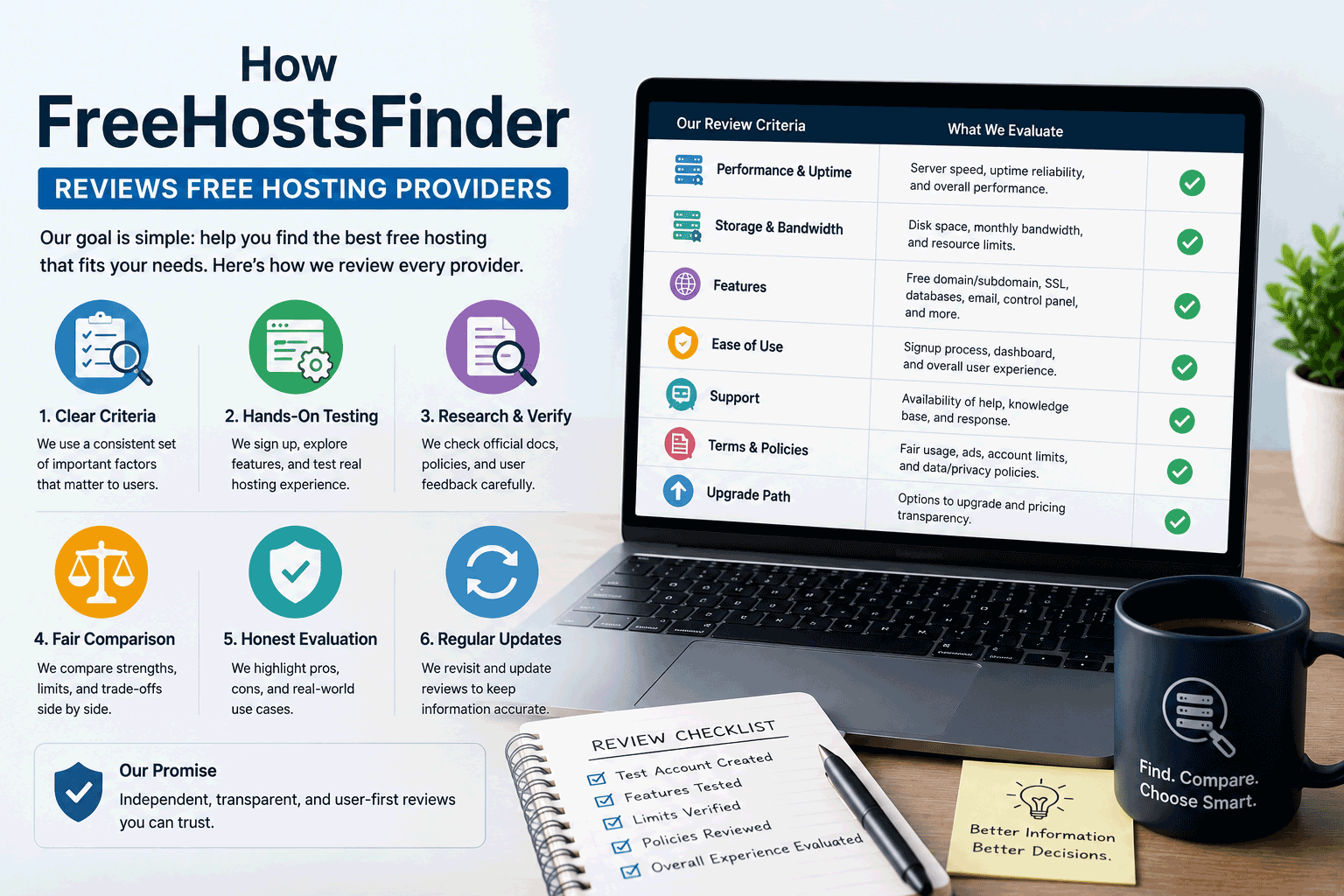
This page explains how we review free hosting providers and what readers can expect from our provider profiles.
Our review goal is simple: help users choose more clearly
FreeHostsFinder is built for people who want to understand free and low-cost hosting options without getting lost in technical language.
Some readers may be complete beginners. Some may be students. Some may be developers. Some may want WordPress. Some may only need a simple static website. Some may be building a portfolio, a landing page, a small business draft, or a test project.
Because users have different needs, we do not believe one hosting provider can be the best choice for everyone.
Our review goal is not to create hype around every free plan. It is to help readers understand whether a provider fits their real website purpose.
A good free host for one user may be the wrong choice for another. Our reviews are written with that practical view in mind.
We look at the type of hosting first
Before reviewing features, we first look at what kind of hosting the provider offers.
Free hosting is not one single category anymore. It can include:
- traditional web hosting
- free WordPress hosting
- static website hosting
- website builders
- developer hosting
- cloud free tiers
- landing page builders
- AI-assisted website builders
This matters because each type serves a different purpose.
A traditional free hosting provider may support PHP and MySQL, which can be useful for WordPress testing or learning backend basics.
A static hosting platform may be better for portfolios, documentation, student projects, and front-end websites.
A website builder may be better for users who want to create a website without coding.
A developer platform may be ideal for people building frontend apps or testing modern frameworks.
So in every review, we try to explain what type of platform the provider is and what kind of website it is most suitable for.
We check who the provider is best for
A provider review should not only list features. It should explain the best use cases.
For example, a free hosting service may be best for:
- students learning web development
- beginners testing their first website
- WordPress practice
- personal portfolios
- static websites
- documentation sites
- small landing pages
- developer demos
- simple business drafts
- no-code website creation
This helps readers quickly understand whether the provider matches their situation.
A beginner who wants a drag-and-drop website builder does not need the same recommendation as a developer deploying a static site from Git. A small business owner does not need the same advice as a student testing HTML and CSS.
That is why our reviews focus on fit, not only features.
We also explain who should avoid it
A good review should be honest about limitations.
If a provider is not ideal for certain users, we try to say that clearly.
For example, a free hosting provider may not be suitable for:
- serious business websites
- high-traffic blogs
- online stores
- websites requiring strong support
- users who need full WordPress control
- projects needing large storage
- users who need guaranteed performance
- websites that must avoid ads or branding
- projects that need easy migration
- users who are not comfortable with technical setup
This does not mean the provider is bad. It simply means it may not be the right tool for that use case.
Free hosting can be very useful when expectations are clear. It becomes frustrating when users choose a plan that does not match their needs.
We check whether the free plan is truly useful
Some free plans are generous enough for real testing and small projects. Others are more limited and mainly work as a preview before upgrading.
Both types can be acceptable, but readers should understand the difference.
When reviewing a free plan, we check whether it provides enough value for actual use. We look at what users can realistically do before paying.
For example:
- Can users publish a real website?
- Can they test WordPress?
- Can they upload custom files?
- Can they connect a custom domain?
- Can they use HTTPS?
- Can they build something beyond a basic demo?
- Are the limits clear?
- Does the free plan feel practical or only promotional?
A free plan does not need to be perfect. But it should be clear and useful for its intended audience.
We check ads and provider branding
One of the most important review points is whether ads or provider branding appear on user websites.
This matters because ads can affect trust.
For a practice project, ads may not be a major issue. But for a portfolio, small business website, landing page, or public blog, forced ads can make the website feel less professional.
In our reviews, we look for details such as:
- whether forced ads appear
- whether provider branding appears
- whether branding can be removed
- whether removal requires a paid plan
- whether ads appear on all free websites or only under certain conditions
A free host with no ads can be more attractive for public-facing projects, but it may still have other limits. That is why ads are only one part of the review, not the whole judgment.
We check custom domain support
Custom domain support is another key point.
A free subdomain is fine for learning, testing, or temporary use. But for a serious project, a custom domain can make a website look more professional and easier to remember.
When reviewing providers, we check whether users can connect their own domain on the free plan.
We also look at whether custom domain support requires upgrading and whether SSL works properly with custom domains.
This is important because many beginners assume free hosting includes everything they need, only to discover later that custom domains are locked behind a paid plan.
A provider that supports custom domains on a free plan may be more useful for portfolios, small public websites, and early-stage projects.
We check SSL and HTTPS
HTTPS is now expected for most websites.
A website without HTTPS may look less trustworthy, and browsers may warn visitors that the site is not secure.
In our provider reviews, we check whether SSL is included and how easy it is to enable.
We also pay attention to whether SSL works only on provider subdomains or also on custom domains.
This point is especially important for public websites, portfolios, blogs, landing pages, and any site with contact forms.
Even if a hosting plan is free, HTTPS should still be part of the basic experience whenever possible.
We check storage and bandwidth limits
Storage and bandwidth are common free hosting limits.
Storage affects how many website files, images, themes, plugins, documents, and backups a site can use.
Bandwidth affects how much data the website can deliver to visitors.
A small static website may not need much storage or bandwidth. A WordPress blog with many images may need more. A portfolio with large visuals may also use storage quickly.
In our reviews, we look at whether the stated limits are suitable for the provider’s intended use case.
We do not only ask whether the number looks big. We ask whether it is practical for the kind of website the provider is likely to support.
We check WordPress support carefully
Many users search for free hosting because they want to try WordPress.
But not every free host is suitable for WordPress.
WordPress needs PHP, a database, storage, memory, and a hosting environment that can handle themes, plugins, updates, and media files.
When reviewing providers that claim to support WordPress, we look at points such as:
- whether WordPress installation is possible
- whether PHP and database support are included
- whether storage is enough for basic use
- whether plugin and theme use is restricted
- whether performance is acceptable for testing
- whether backups and migration are possible
- whether the provider is better for learning or serious publishing
Free WordPress hosting can be useful for practice, but it may not be ideal for long-term blogs or business sites. Our reviews try to make that difference clear.
We check database and PHP support
For traditional hosting, database and PHP support are important.
Many dynamic websites need database access. WordPress, some CMS platforms, PHP applications, forums, and learning projects may require MySQL or MariaDB.
In our reviews, we check whether the free plan includes database support, how many databases are allowed, and whether the limits are suitable for learning or real use.
This is especially important for students and beginners practicing backend development.
A hosting provider may be good for static pages but not suitable for PHP/MySQL projects. Our reviews aim to explain that difference clearly.
We check ease of use
A hosting provider may have useful features, but if the platform is confusing, beginners may struggle.
Ease of use matters a lot.
When reviewing providers, we consider whether the platform feels suitable for its target users.
For beginner-friendly hosting, we look at:
- simple signup process
- clear dashboard
- easy website publishing
- understandable settings
- helpful documentation
- simple domain connection steps
- easy SSL setup
For developer-focused hosting, we look at:
- Git deployment
- build settings
- framework support
- preview deployments
- command-line or repository workflow
- documentation quality
Not every provider needs to be easy for everyone. A developer platform can be technical and still be excellent for developers. A beginner platform can be simple and still be useful for non-technical users.
The key is whether the experience matches the intended audience.
We check performance expectations
Performance is difficult to judge only from marketing claims.
Free hosting performance can vary depending on resources, traffic, server location, website type, and provider limits. Because of that, we are careful about making broad performance promises.
In reviews, we focus on practical expectations.
For example, static hosting platforms may be very fast for simple static sites. Traditional free hosting may be acceptable for small projects but may not be ideal for high-traffic or resource-heavy websites. Free WordPress hosting may work for learning but feel limited after adding plugins and media.
We try to explain performance in real-world terms rather than only using technical buzzwords.
A free host does not need to be the fastest option in the market. It only needs to be suitable for the website purpose.
We check support options
Support matters more when something goes wrong.
Free plans often come with limited support. Some providers offer documentation and community forums. Others offer ticket support only to paid users. Some may provide basic help but not advanced troubleshooting.
In our reviews, we check what kind of support users can expect.
This is important because free hosting is often used by beginners who may need guidance.
Limited support is not always a dealbreaker, especially for learning projects. But for public or business websites, weak support can become a risk.
We try to make support expectations clear so users do not assume they will receive premium-level help on a free plan.
We check backup options
Backups are often overlooked by beginners.
A website can break. Files can be deleted. WordPress updates can cause issues. Accounts can have problems. Mistakes happen.
When reviewing free hosting providers, we check whether backup options are included, whether they are automatic or manual, and whether backups are available only on paid plans.
If a provider does not offer backups, users may still be able to create their own. But they should know that responsibility before building something important.
For any website with real content, backup access is a major factor.
We check migration and export options
A free hosting provider should not quietly trap users.
One of the most important review points is whether users can move their website later.
Migration matters because many websites start small and grow. A student project may become a portfolio. A test blog may become a real content site. A business draft may become a public website.
In our reviews, we look at whether users can access or export:
- website files
- WordPress files
- databases
- media uploads
- content
- domain settings
- backups
This is especially important for website builders, where the website may be easy to create but harder to move.
A platform with clear export and migration options gives users more confidence.
We check upgrade pricing and next steps
Free hosting is often the beginning of a journey, not the final destination.
That is why we check the paid upgrade path.
A good free plan should have a reasonable next step if the website grows.
In our reviews, we look at:
- what paid plans unlock
- whether ads or branding can be removed
- whether custom domains are included
- whether storage and bandwidth increase
- whether support improves
- whether backup options become available
- whether pricing is clear
- whether renewal prices are easy to understand
We do not judge a provider only by the free plan. We also consider whether the user has a practical path forward.
We check usage rules and restrictions
Free hosting plans often come with rules.
These rules may cover fair usage, CPU limits, file types, scripts, email sending, inactivity, traffic sources, commercial use, or prohibited content.
These rules exist to protect the platform from abuse, but they can also affect normal users if they are not clear.
In our reviews, we look for important restrictions that may affect typical website owners.
For example, a provider may not allow file storage sites, heavy scripts, large downloads, or certain commercial activities. A free account may also be suspended after long inactivity.
Users should know these limits before relying on a provider.
We check whether the provider fits modern website needs
Free hosting today is not only about classic shared hosting.
Many users now build static websites, frontend apps, documentation pages, no-code pages, AI-assisted websites, and Git-based projects.
Because of that, FreeHostsFinder reviews providers across different hosting styles.
We try to consider whether a provider fits modern needs such as:
- static site deployment
- frontend frameworks
- Git integration
- SSL by default
- custom domain support
- simple dashboards
- no-code editing
- WordPress testing
- beginner education
- low-cost upgrade paths
This helps us cover both traditional free hosting and newer website publishing methods.
We avoid calling one provider “best for everyone”
Free hosting recommendations can become misleading when they claim one provider is the best for all users.
FreeHostsFinder avoids that approach.
A provider may be excellent for static websites but not suitable for WordPress. Another may be useful for PHP/MySQL learning but not ideal for polished business sites. A website builder may be perfect for a beginner but too limited for a developer.
Instead of forcing one ranking for everyone, we focus on use cases.
We may describe a provider as:
- best for students
- good for static websites
- useful for WordPress testing
- better for developers
- suitable for simple portfolios
- not ideal for business websites
- good for quick drafts
- better as a temporary solution
This gives readers a more realistic way to decide.
We try to separate facts from opinion
Hosting plans can change over time.
Storage limits, bandwidth policies, free plan features, upgrade prices, support options, and terms can all be updated by providers.
Because of that, FreeHostsFinder aims to separate factual details from editorial opinion.
Facts are things like whether a provider lists custom domain support, SSL, storage limits, or WordPress features.
Opinion is our interpretation of who the provider may be suitable for and what users should be careful about.
We encourage readers to check the provider’s official website before signing up, especially for plan limits and pricing.
A good review should be helpful, but users should always confirm current details before making a final decision.
Our basic provider review structure
To make reviews easier to read, we aim to use a consistent structure.
A typical FreeHostsFinder provider review may include:
- short introduction
- quick summary
- best for
- not ideal for
- free plan overview
- key features
- important limitations
- ads and branding details
- custom domain and SSL support
- WordPress or database support if relevant
- ease of use
- support and backup notes
- upgrade path
- alternatives
- final opinion
- FAQ section
This structure helps readers compare providers more easily.
When each review follows a similar format, visitors can quickly find the information they care about.
We focus on practical reader questions
Our reviews are written around questions real users may ask.
For example:
- Can I use this for my first website?
- Is it good for WordPress?
- Will ads appear on my site?
- Can I connect my own domain?
- Is SSL included?
- Can I move my website later?
- Is this suitable for a portfolio?
- Is this okay for a small business?
- What are the main limits?
- When should I upgrade?
- Who should avoid this provider?
These questions are more useful than simply repeating a feature list.
A hosting review should help readers make a decision, not just describe a product.
We consider beginner experience seriously
Many visitors looking for free hosting are new to website creation.
They may not fully understand terms like bandwidth, DNS, SSL, PHP, database, CDN, CMS, FTP, or deployment.
That is why our reviews aim to explain things in simple language whenever possible.
We do not want readers to feel lost because of unnecessary jargon.
At the same time, we still want the content to be accurate enough for practical decisions.
The goal is to make hosting easier to understand without making it feel too simplified or careless.
We consider trust and website purpose
A hosting provider is not only a technical choice. It affects how visitors experience a website.
For public websites, trust matters.
That is why our reviews pay attention to things like ads, branding, custom domains, HTTPS, speed, mobile experience, support, and reliability expectations.
For example, a free host may be fine for testing but not ideal for a business website if it shows ads or lacks support. A provider subdomain may be okay for learning but less professional for a portfolio.
We try to evaluate hosting based on the purpose of the website, not only the number of features.
We do not ignore limitations
Every free plan has limits.
A review that only talks about benefits is not useful.
FreeHostsFinder reviews aim to mention limitations clearly, without exaggerating or being unfair.
A limitation is not always a reason to avoid a provider. Sometimes it simply defines the right use case.
For example, limited storage may be acceptable for a simple static site. Limited support may be acceptable for a learning project. No database support may be fine for a portfolio but not for WordPress.
Our goal is to help readers understand whether the limitation matters for their specific project.
We look at alternatives when helpful
Sometimes a provider is not the best fit for a reader’s need.
In those cases, alternatives can help.
For example:
- if a user needs static hosting, a developer/static platform may be better than traditional hosting
- if a user needs WordPress, a WordPress-capable host may be better than a website builder
- if a user wants the easiest setup, a website builder may be better than traditional hosting
- if a user needs professional business use, a low-cost paid plan may be safer than free hosting
Alternatives help readers avoid forcing the wrong platform into the wrong use case.
We review free hosting as a starting point, not a miracle solution
Free hosting has real value.
It helps people start online, learn new skills, test ideas, publish small websites, and explore platforms without paying first.
But free hosting should not be treated as a perfect solution for every website.
Our reviews are based on the idea that free hosting is often a starting point. It can be excellent for early-stage use, but websites may eventually need better performance, support, storage, backups, security, domains, or professional features.
That is why we also talk about when users may need to upgrade.
Starting free is fine. Getting stuck because expectations were unclear is the problem.
Our review promise to readers
FreeHostsFinder aims to keep reviews practical, honest, and easy to understand.
Our promise is to help readers answer three important questions:
Is this provider useful for my website type?
What should I be careful about before signing up?
What is my next step if the website grows?
If a review helps a reader answer those questions, it has done its job.
We are not here to make every free hosting provider sound perfect. We are here to help users choose with more confidence.
Final thoughts
Reviewing free hosting providers is not only about comparing storage, bandwidth, or free plan labels.
It is about understanding real use cases.
A good provider review should explain who the service is for, what it supports, where it may be limited, whether it shows ads, whether custom domains and SSL are available, whether WordPress or databases are supported, whether migration is possible, and whether the upgrade path makes sense.
At FreeHostsFinder, we want to make free hosting easier to compare and easier to understand.
Free hosting can be a smart way to start online, but the right choice depends on your website purpose, skill level, and future plans.
That is why our reviews focus not only on what a provider offers, but also on what it means for real users.
Our goal is simple: to help you start with confidence, avoid common mistakes, and choose a hosting provider that fits where your website is today, and where it may go tomorrow.
Leave a Reply
You must be logged in to post a comment.