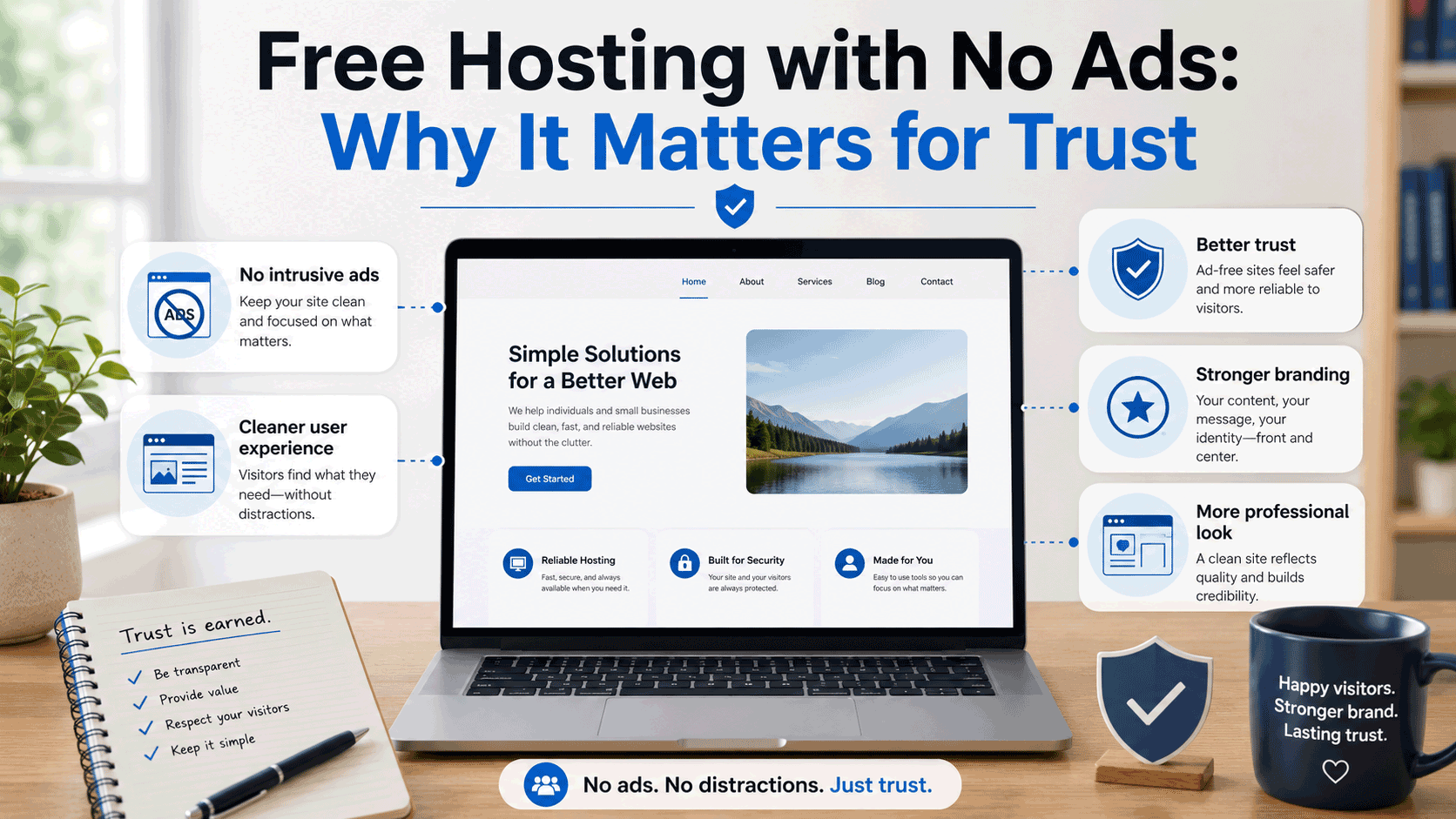
Free hosting can be a helpful way to start a website without paying for hosting first.
It gives beginners, students, creators, small business owners, and project builders a chance to publish something online with lower risk. You can test an idea, learn how hosting works, build a small portfolio, try a simple blog, or create a temporary landing page before deciding whether to invest in a paid plan.
But when choosing free hosting, there is one detail that many people overlook:
Will ads appear on your website?
This may sound like a small point at first. After all, if the hosting is free, some people may expect ads to be part of the deal. For a private test site or short-term practice project, ads may not matter much.
But if your website is public, ads can affect how people feel about your site.
They can affect trust, professionalism, visitor experience, and even whether someone takes your content, project, portfolio, or business seriously.
That is why free hosting with no ads can be more important than many beginners realize.
Why ads appear on some free hosting plans
Free hosting providers still have real costs.
They need servers, storage, bandwidth, software, maintenance, security, support, and people to keep the platform running. Even when users are not paying directly, the provider still needs a way to support the service.
Some providers do this by offering free plans with limits and encouraging users to upgrade later. Some use free plans as an entry point to paid services. Some display branding. Some place ads on free websites.
This is understandable from a business point of view.
But from a website owner’s point of view, it is important to know what kind of trade-off you are accepting.
A free hosting plan with ads is not automatically bad. It may be acceptable for some situations. But it is not the same as a free hosting plan with no forced ads.
The difference matters when visitors are involved.
Ads can change the first impression
Visitors judge a website quickly.
Before they read every word, they notice the layout, speed, domain name, design, and overall feeling of the page. If they see unrelated ads, popups, banners, or strong provider branding, it can change how they feel about the website.
Even if your content is good, ads can make the site feel less polished.
For a hobby test page, this may not be a serious issue. But for a business website, portfolio, personal brand, or public project, first impression matters.
A visitor may not understand that the ads come from your free hosting provider. They may simply assume the website owner placed them there or that the site is not very professional.
This is why ads are not only a visual issue. They are also a trust issue.
No-ads hosting helps your message stay clear
Every website has a purpose.
A portfolio wants to show your work.
A business website wants to explain services and gain inquiries.
A blog wants people to read the content.
A landing page wants visitors to take one action.
A student project wants to present work clearly.
A nonprofit page wants to build support or share information.
Ads can compete with that purpose.
They can pull attention away from your message. They may promote something unrelated. They may make the page look crowded. They may distract visitors before they understand what your website is about.
A no-ads hosting environment gives your content more space to breathe.
The visitor sees your website, your message, your design, and your call to action — not a random ad placed by the hosting provider.
For many public websites, that cleaner experience is valuable.
Ads can reduce professionalism
Professionalism is not only about having a beautiful design.
It is also about consistency, clarity, and control.
When forced ads appear on a website, you lose some control over the visitor experience. You may not decide where the ads appear, what they look like, or what they promote.
This can be a problem for websites that need to look serious.
For example, if you are using a website as a portfolio, potential employers or clients may expect a clean presentation. If the website shows unrelated ads, it may feel less polished.
If you run a small business, visitors may wonder why another company’s advertisements are appearing on your page.
If you are building a personal brand, forced ads can make your website feel less independent.
No-ads hosting helps your website look more intentional and professional, even if it is simple.
Ads can affect visitor trust
Trust is one of the most important parts of a website.
Visitors need to feel that the website is safe, reliable, and worth their attention. This is especially true if you want them to contact you, read your content, download something, submit a form, or consider your service.
Ads can weaken trust when they feel intrusive or unrelated.
Some ads may look harmless. Others may look aggressive, distracting, or low quality. Popups, flashing banners, misleading buttons, or unrelated offers can make visitors uncomfortable.
Even if you did not choose those ads, they still appear on your website.
This can be risky because visitors usually do not separate the hosting provider from the website owner. They experience the page as one thing.
If the page feels messy, the trust goes down.
Ads may affect mobile experience
Many visitors browse websites on mobile phones.
On a smaller screen, ads can become more noticeable and more disruptive. A banner that looks acceptable on desktop may take too much space on mobile. A popup may cover important content. A sticky ad may make the page harder to read.
This can hurt the user experience.
If a visitor has to close ads, scroll around banners, or avoid accidental clicks, they may leave the website sooner.
For a simple website, mobile clarity is very important. Many small business searches, portfolio views, and quick website visits happen from phones.
A no-ads website usually feels cleaner and easier to use on mobile.
Free hosting with no ads can still have limits
It is important to be realistic.
A free hosting plan with no ads does not mean there are no limitations.
The provider may still limit storage, bandwidth, CPU usage, database size, file uploads, support, email, backups, or advanced features.
No ads is a valuable benefit, but it is not the only thing to check.
A no-ads free host can still be slow. It may still have strict resource limits. It may still lack backups. It may not support custom domains. It may not be suitable for WordPress. It may have a limited upgrade path.
So while “no ads” is important for trust, it should be part of a wider review.
The best free hosting option is not only ad-free. It should also match your website purpose.
Ads vs provider branding
Ads and branding are related, but they are not exactly the same.
An ad is usually a promotional message, banner, popup, or sponsored content shown on your website.
Provider branding may be something like “Powered by…” in the footer, a small badge, or a platform label.
Both can affect professionalism, but ads are often more disruptive.
A small footer badge may be acceptable for some projects. A large banner or popup may not be.
Before choosing a free host, check exactly what appears on your website.
Some providers may say “no ads,” but still include branding. Others may allow no forced ads but include platform marks on free plans. Some remove all branding only after upgrading.
Read the details carefully.
When ads may be acceptable
Ads are not always a dealbreaker.
If you are building a temporary test site, practicing web development, creating a private demo, or learning how hosting works, ads may not matter much.
For example, a student testing a simple page may not care if a small ad appears. Someone trying a platform for one day may not need a perfect visitor experience. A hobby project with no public audience may be fine with some trade-offs.
The key is context.
Ads become a bigger concern when the website is public, professional, or connected to trust.
So the question is not only “Are ads bad?”
The better question is:
“Will ads affect the purpose of this website?”
If the answer is yes, then no-ads hosting becomes much more important.
When no-ads hosting matters most
No-ads hosting is especially important for websites where presentation and trust matter.
This includes:
- small business websites
- personal portfolios
- freelancer pages
- professional blogs
- landing pages
- nonprofit or community websites
- school or university project showcases
- client-facing demos
- personal brand websites
- service introduction pages
For these websites, visitors are not only looking at information. They are also forming an opinion.
A clean, ad-free website can help the site feel more reliable and focused.
No ads can make a simple website feel better
A website does not need to be complex to feel professional.
Sometimes a simple website with a clean layout, clear text, fast loading, HTTPS, and no ads can feel much better than a feature-heavy website filled with distractions.
This is especially true for small websites.
If you are building a simple portfolio, one-page business site, or landing page, the experience should feel calm and direct. Visitors should understand who you are, what you offer, and what they should do next.
Forced ads can interrupt that simplicity.
A no-ads free host can help a basic website feel more polished without requiring a large budget.
Ads can conflict with your website purpose
Another concern is that ads may not match your website topic.
For example, your website may be about a professional service, but ads may show unrelated products. Your portfolio may show creative work, but ads may distract from your design. Your educational page may include ads that do not fit the learning context.
In some cases, ads may even promote competitors or unrelated services.
You may not have control over what appears.
This can create an awkward experience, especially if the website is meant to communicate a clear and specific message.
No-ads hosting gives you more control over your own page.
Custom domain plus no ads is a stronger combination
A custom domain helps your website look more independent. No-ads hosting helps your website look cleaner.
Together, they can make a free-hosted website feel much more professional.
For example, a portfolio using a custom domain and no forced ads will usually look more trustworthy than a site using a long provider subdomain with banners and popups.
This does not mean every beginner must buy a domain immediately. But if your website is public and you care about trust, the combination of custom domain, HTTPS, and no ads is worth considering.
It creates a stronger foundation, even if the website itself is simple.
No ads does not replace good content
While no-ads hosting helps trust, it is not enough by itself.
Your website still needs good content, clear structure, readable design, working links, mobile-friendly pages, and useful information.
A clean website with weak content will not perform well. But good content placed in a clean, ad-free environment has a better chance of being taken seriously.
Think of no-ads hosting as a cleaner stage for your website.
It does not write your message for you, but it helps visitors focus on that message without unnecessary noise.
What to check before choosing free hosting with no ads
Before choosing a free hosting provider, check whether “no ads” really means no forced ads on your website.
Look for clear information about:
- banner ads
- popups
- footer branding
- provider badges
- promotional links
- injected scripts
- ads on subdomains
- ads on error pages
- branding removal options
- whether ads appear only after inactivity or high usage
Also check whether no-ads support applies to the free plan, not only paid plans.
Some providers may mention no ads, but the details can depend on the plan type.
If possible, create a test site and view it on desktop and mobile. This is one of the easiest ways to see what visitors will actually experience.
Do not forget the other hosting basics
After checking ads, also check the rest of the hosting features.
A good free hosting choice should still be reviewed for:
- storage limits
- bandwidth limits
- SSL/HTTPS
- custom domain support
- website speed
- uptime expectations
- backup options
- database support
- WordPress compatibility
- support availability
- migration options
- upgrade pricing
- usage rules
No ads is important, but it should not be the only reason you choose a host.
A free host with no ads but poor performance may still be a weak choice for some websites. A host with no ads but no migration option may still create problems later.
Choose based on the full picture.
Free hosting with no ads for portfolios
For portfolio websites, no-ads hosting is especially useful.
A portfolio should keep attention on your work. It may show your design projects, writing samples, code projects, photos, case studies, resume, or professional background.
Ads can make the portfolio feel less serious.
If you are sharing your portfolio with employers, clients, or collaborators, a clean presentation matters. Even if the website is simple, it should feel intentional.
For portfolios, no forced ads should be one of the first things to check.
Free hosting with no ads for small businesses
For small business websites, trust is everything.
A small business site may not need advanced features, but it should look reliable. Visitors may use the site to decide whether to call, message, visit, request a quote, or buy something.
Forced ads can weaken that trust.
If a free hosting plan shows ads, it may be better to use it only for drafting or testing, not as the final public website.
For a real business site, no ads, a custom domain, HTTPS, and working contact methods are usually more important than having a long feature list.
Free hosting with no ads for students
For students, ads may or may not matter depending on the project.
If the website is only for practice, ads may be acceptable. But if the student is building a portfolio, final project showcase, or website to share with future employers, no-ads hosting is better.
A clean project page helps teachers, classmates, or employers focus on the work itself.
Students who are learning web development should also pay attention to whether the hosting platform injects ads into the page code, because this may affect layout or testing.
For serious student work, no-ads hosting can make the project look more polished.
Free hosting with no ads for blogs
For blogs, ads can be a sensitive issue.
Some bloggers may eventually want to monetize their own content with ads or affiliate links. If the hosting provider already places forced ads on the site, the blogger has less control over the reading experience.
Even for non-monetized blogs, forced ads can distract readers.
A blog depends on attention. Readers need a comfortable space to read, scroll, and explore more posts.
A free blog with no ads usually creates a better reading experience.
However, bloggers should also check storage, speed, backups, SEO settings, and migration options before choosing a platform.
How ads can affect call-to-action pages
Landing pages and call-to-action pages are built around focus.
They usually ask visitors to do one thing: sign up, contact, download, register, request information, or visit another page.
Ads can reduce that focus.
If a visitor is distracted by an unrelated banner or popup, the page may not perform as well. Even worse, they may click away from your page.
For landing pages, the cleaner the experience, the better.
This is why no-ads hosting can matter even for very simple one-page websites.
Is no-ads free hosting too good to be true?
Not always.
Some providers offer free hosting without forced ads because they use other business models. They may encourage upgrades, offer paid premium plans, limit resources, sell related services, or use free plans to attract long-term customers.
That can be perfectly reasonable.
But users should still be careful.
If a provider offers free hosting with no ads, check how the service is supported. Are there clear limits? Is there a paid upgrade path? Are the terms understandable? Does the provider look stable?
A no-ads promise is valuable, but transparency is also important.
How to compare ad-free free hosting options
When comparing ad-free hosting options, do not stop at “no ads.”
Try to compare based on website purpose.
For a static portfolio, check speed, custom domain support, HTTPS, and ease of updating.
For WordPress testing, check PHP, database support, storage, backups, and plugin flexibility.
For student projects, check ease of publishing, file access, and whether the project can be shared reliably.
For small business pages, check custom domain support, mobile performance, contact forms, no ads, and upgrade options.
The right ad-free host is the one that matches your project, not just the one that removes banners.
A simple trust checklist
Before using free hosting for a public website, ask:
- Will visitors see forced ads?
- Will provider branding appear?
- Does the site use HTTPS?
- Can I use a custom domain?
- Does the website load reasonably fast?
- Does it work well on mobile?
- Are contact forms or links working?
- Can I back up the site?
- Can I move the website later?
- Does the free plan look suitable for public visitors?
These points help you judge whether the free host can support trust, not just publishing.
How FreeHostsFinder wants to help
At FreeHostsFinder, we believe free hosting should be easier to understand.
Many users focus only on storage, bandwidth, or whether the plan is free. But the visitor experience matters too. Ads, branding, speed, domain support, SSL, backups, and migration all affect whether a website feels trustworthy.
Our goal is to help readers look at free hosting more practically.
A free hosting plan can be useful, but it should match the purpose of the website. If your site is public and trust matters, no-ads hosting can be a major advantage.
We want to help users compare these details clearly before they spend time building.
Final thoughts
Free hosting with no ads can make a real difference.
It helps your website feel cleaner, more focused, and more professional. It allows visitors to pay attention to your message instead of being distracted by unrelated banners or popups.
For learning projects, ads may not always matter. But for portfolios, small business websites, blogs, landing pages, public projects, and personal brands, no-ads hosting can strongly affect trust.
Still, no ads should not be the only thing you check.
A good free hosting choice should also support your website type, offer reasonable performance, provide HTTPS, allow backups or migration, and have a clear upgrade path.
Free hosting can be a useful starting point. But if your website is meant to be seen, trusted, and taken seriously, choosing a no-ads option can help your content stand on its own.
Your website should represent your message — not someone else’s advertisement.
Leave a Reply
You must be logged in to post a comment.