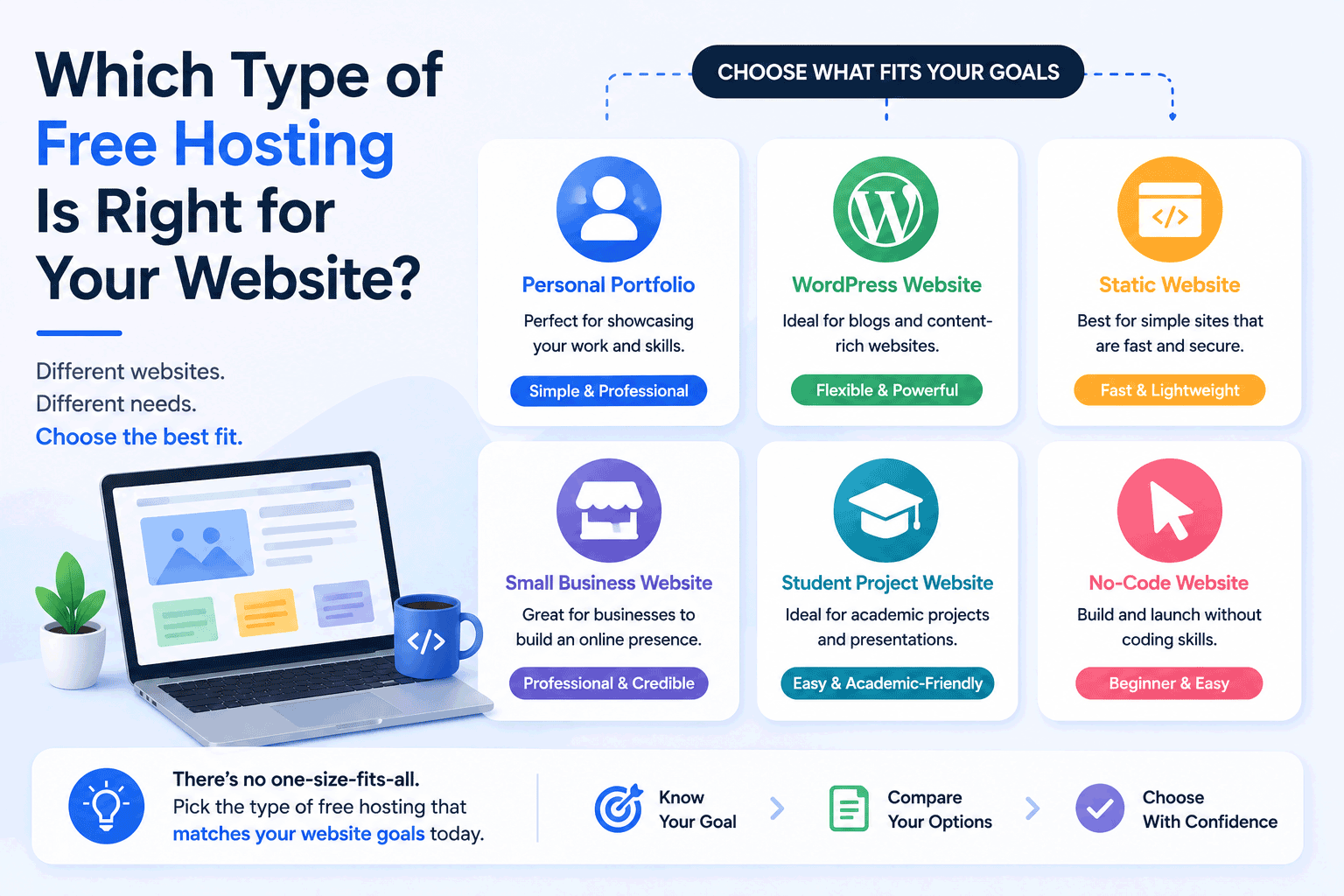
Free hosting can be a helpful way to start building online, but the best choice depends heavily on what kind of website you want to create.
This is where many beginners get confused.
They search for “free hosting” and expect all free hosting services to do the same thing. But today, free hosting comes in many different forms. Some platforms are made for simple static websites. Some are designed for WordPress. Some work like drag-and-drop website builders. Some are better for developers. Some are useful only for testing, while others can support a small public website quite well.
So, instead of asking only, “What is the best free hosting?”, it is better to ask:
“Which type of free hosting is right for my website?”
That small change in thinking can help you avoid choosing a platform that looks good at first but does not really fit your project.
Free hosting is not one-size-fits-all
A personal portfolio, a student project, a WordPress blog, a small business website, and a developer test project do not all need the same hosting setup.
For example, a simple portfolio may only need fast static hosting. A WordPress blog needs database and PHP support. A small business website may need a custom domain, contact form, SSL, and a professional look. A student project may need something simple and free without complicated setup. A developer may prefer Git deployment and more technical control.
This is why choosing free hosting should begin with your website purpose, not the provider name.
A free host can be excellent for one type of user and completely unsuitable for another. That does not always mean the host is bad. It may simply mean it was not built for your kind of website.
1. Personal portfolio websites
A personal portfolio is usually created to show your work, skills, projects, resume, design samples, writing, photography, or professional background.
For this type of website, the most important things are presentation, speed, reliability, and a clean visitor experience.
You may not need advanced hosting features at the beginning. If your portfolio is mostly made of pages, images, project descriptions, and contact information, a static website hosting platform or simple website builder may be enough.
Static hosting can be a good fit because portfolio websites usually do not need complicated backend functions. They can load quickly, stay simple, and be easier to maintain.
However, there are a few things to check carefully. If you want to use your portfolio for job applications, client proposals, or personal branding, you should avoid platforms that show forced ads or make your website look unprofessional. You should also check whether a custom domain is supported, even if you do not plan to use one immediately.
Best fit: static website hosting, simple website builders, portfolio-focused platforms
Watch out for: forced ads, limited design control, no custom domain support, difficult migration
2. Student projects and learning websites
Free hosting is especially useful for students and beginners.
If you are learning HTML, CSS, JavaScript, WordPress, PHP, or basic web development, free hosting gives you a place to practice without paying first.
For a simple school project or coding practice, you may not need premium performance or advanced features. You mainly need a platform that lets you publish your work, test your pages, and understand how websites behave online.
If your project is made with only HTML, CSS, and JavaScript, static hosting may be a good choice. If your course requires PHP, MySQL, or WordPress, you will need a traditional hosting environment that supports those technologies.
This is an important difference. A static hosting platform may be very good for front-end learning, but it will not be suitable if your assignment requires a database.
For students, the best free hosting is usually the one that matches the lesson or project requirement with the least setup difficulty.
Best fit: static hosting for front-end projects, traditional free hosting for PHP/MySQL, free WordPress hosting for WordPress practice
Watch out for: missing database support, file upload limits, short inactivity periods, unclear account rules
3. WordPress blogs
WordPress is one of the most popular ways to create a blog or content website, but it needs more resources than a basic static website.
A WordPress site usually requires PHP, a database, storage for themes and plugins, and enough server resources to run smoothly. This means not every free hosting service is a good fit for WordPress.
Some free hosts may allow WordPress installation, but the experience can be limited. The website may load slowly, storage may run out quickly, plugin installation may be restricted, or backups may not be included.
Free WordPress hosting can still be useful if you want to learn WordPress, test themes, understand the dashboard, or create a small experimental blog. But if your goal is to build a long-term content website, a professional blog, or a site that you plan to grow, you should check the limitations very carefully.
For WordPress, migration also matters. If you build your site on a free platform and later want to move to paid hosting, you should know whether you can export your content, files, and database.
Best fit: free WordPress hosting for learning and testing, low-cost WordPress hosting for more serious use
Watch out for: slow performance, plugin restrictions, limited database access, no backup, difficult migration
4. Static websites
A static website is usually made with fixed files such as HTML, CSS, JavaScript, images, and other assets. It does not need a database to generate pages dynamically.
This type of website can be ideal for portfolios, documentation pages, landing pages, simple business profiles, personal pages, open-source project pages, and front-end experiments.
Static hosting is often fast, lightweight, and clean. Many static hosting platforms are also developer-friendly, especially when they support Git-based deployment.
For users who do not need WordPress or server-side features, static hosting can be one of the best free hosting options available.
However, static hosting is not right for everything. If you need user login, WordPress plugins, dynamic database content, online store functions, or server-side scripts, static hosting may not be enough by itself.
Static hosting is best when your website is simple, content is mostly fixed, and you want speed and reliability without managing a traditional hosting account.
Best fit: portfolios, landing pages, documentation, front-end projects, simple websites
Watch out for: no built-in database, limited backend functions, may require technical setup for forms or CMS features
5. Small business websites
A small business website has different needs from a test project.
Even if the website is simple, it represents your business. Visitors may use it to check your services, contact details, credibility, opening hours, location, portfolio, or pricing information.
For this reason, free hosting should be used carefully for business websites.
A free plan may be acceptable for an early draft or temporary test, but it may not always be suitable for a public business website. Forced ads, slow loading, no custom domain, limited support, or unreliable uptime can affect how people see your business.
If you still want to start with free hosting, choose a platform that looks clean, supports HTTPS, allows a custom domain, and gives you a clear upgrade path. You should also check whether contact forms, email, backups, and mobile-friendly design are available.
For business use, the question is not only whether the hosting is free. The question is whether it helps your business look trustworthy.
Best fit: website builders with clean templates, static sites for simple business profiles, free plans with upgrade options
Watch out for: ads, provider branding, no custom domain, weak support, poor speed, no backup options
6. Developer testing and prototypes
Developers often need free hosting for testing, demos, prototypes, open-source projects, API experiments, or early product ideas.
In this case, the best free hosting option depends on the technology stack.
For front-end applications, static hosting or developer platforms with Git deployment can work very well. For backend applications, you may need cloud free tiers, serverless platforms, container hosting, or traditional hosting with specific runtime support.
Developer-focused hosting is usually more flexible, but it can also be more technical. It may require knowledge of Git, build commands, environment variables, deployment settings, and resource limits.
For developers, free hosting is very useful for experimentation. But it is important to check usage limits, sleeping apps, request limits, build minutes, storage, bandwidth, and whether the free tier is suitable for public demos.
A developer platform may be powerful, but it may not be beginner-friendly for non-technical users.
Best fit: static hosting, Git-based deployment platforms, cloud free tiers, serverless tools
Watch out for: usage limits, inactive app sleeping, build limits, technical setup, upgrade pricing
7. Landing pages and simple campaign pages
A landing page is usually created for one focused purpose. It may promote a product, collect sign-ups, introduce a service, test an idea, or support a small campaign.
For this type of website, simplicity is important.
You may not need a full hosting account or WordPress installation. A website builder, landing page builder, or static hosting platform may be enough.
The most important things to check are page speed, mobile-friendly design, form support, custom domain support, and whether the page looks professional without forced ads.
If the landing page is only for testing an idea, free hosting can be a good choice. But if the page is part of a paid campaign, customer promotion, or business launch, free hosting limitations may affect results.
A landing page should be easy to publish, easy to update, and clear for visitors.
Best fit: website builders, landing page builders, static hosting
Watch out for: limited form support, ads, slow loading, no analytics, no custom domain
8. No-code websites
No-code website builders are useful for people who want to create a website without touching code.
These platforms usually provide templates, drag-and-drop editors, built-in hosting, forms, design tools, and sometimes AI-assisted page creation. They can be a good fit for beginners, creators, small personal websites, simple business pages, and quick landing pages.
The advantage is ease of use. You can build quickly without learning server settings, FTP, database configuration, or deployment workflows.
But no-code platforms can also come with limitations. You may have less control over the website structure, export options, advanced SEO settings, custom code, or migration. Some free plans may include platform branding or restrict custom domains.
No-code hosting is best when you value speed and simplicity more than full technical control.
Best fit: beginners, simple business pages, portfolios, landing pages, quick websites
Watch out for: platform branding, limited export, design restrictions, paid upgrade requirements
9. AI website builders
AI website builders are becoming more common. They can help generate a first website draft, suggest layouts, create content sections, recommend images, or speed up the design process.
For beginners, this can be helpful because starting from a blank page is often difficult.
However, AI website builders should still be checked like any other hosting platform. The website may be created quickly, but you still need to know where it is hosted, whether you can edit it freely, whether you can use a custom domain, whether the content can be exported, and what happens when you need more features.
AI can help you start faster, but it does not remove the need to understand the hosting limitations.
A fast-generated website is only useful if it can support your real purpose after publishing.
Best fit: quick drafts, idea testing, beginner-friendly website creation, early design exploration
Watch out for: limited editing control, generic content, branding, export restrictions, upgrade costs
How to choose the right type of free hosting
The easiest way to choose is to start from your website type.
If you are building a simple portfolio, static hosting or a website builder may be enough.
If you are learning front-end development, static hosting is usually a good starting point.
If you are practicing WordPress, choose a host that properly supports WordPress, PHP, and databases.
If you are building a business website, prioritize trust, custom domain support, SSL, speed, and upgrade options.
If you are creating a developer prototype, choose a platform that supports your tech stack and deployment workflow.
If you want a quick no-code website, choose a website builder with clear limits and a realistic upgrade path.
The goal is not to find the most popular free host. The goal is to find the host that fits the job.
A simple decision guide
Here is a simple way to think about it:
| Website Need | Better Free Hosting Type |
|---|---|
| Personal portfolio | Static hosting or website builder |
| Student HTML/CSS project | Static hosting |
| WordPress practice | Free WordPress hosting or PHP/MySQL hosting |
| Simple business page | Website builder or static hosting with custom domain support |
| Developer prototype | Git-based hosting, cloud free tier, or serverless platform |
| Landing page | Website builder, landing page builder, or static hosting |
| No-code website | No-code website builder |
| AI-assisted website creation | AI website builder with hosting included |
| PHP/MySQL practice | Traditional free web hosting |
| Documentation site | Static hosting |
This table is only a starting point. The final choice still depends on your exact needs, technical comfort, and future plans.
Do not ignore the next step
When choosing free hosting, many people only think about the first day.
They ask:
“Can I publish my website now?”
That is important, but it is not enough.
You should also ask:
“Can I improve this website later?”
“Can I connect my own domain?”
“Can I remove ads or branding?”
“Can I move the website if needed?”
“Can I upgrade without rebuilding everything?”
“Will this platform still fit if my project grows?”
A good free hosting choice should help you start without blocking your next step.
This is especially important if your website may become more serious later. A small project today can become a portfolio, a business page, a blog, or a public service tomorrow.
Free hosting should match your stage
Free hosting is most useful when it matches your current stage.
If you are learning, choose something simple and forgiving.
If you are testing, choose something quick and flexible.
If you are preparing for public visitors, choose something clean, reliable, and professional-looking.
If you are building for business, be careful with free plans and check whether a low-cost paid plan may be more suitable.
There is nothing wrong with starting free. Many websites begin that way. The important thing is to know why you are choosing free hosting and what role it should play in your project.
Free hosting should support your progress, not limit it too early.
How FreeHostsFinder wants to help
At FreeHostsFinder, we want to make hosting choices easier to understand.
We know that beginners do not always need the most technical explanation. They need practical guidance that helps them decide what fits their situation.
That is why we are rebuilding FreeHostsFinder with a more use-case-focused approach. Instead of treating every free host as the same, we want to help readers understand the differences between platform types, website needs, limitations, and upgrade paths.
Free hosting can be a great starting point, but it works best when users choose with awareness.
Our goal is to help you compare options more clearly and avoid common mistakes before you spend your time building.
Final thoughts
The right type of free hosting depends on what you want to build.
A portfolio, student project, WordPress blog, static website, small business page, landing page, no-code site, and developer prototype may all need different hosting approaches.
There is no single free hosting service that is perfect for everyone.
The best choice is the one that matches your website purpose, gives you enough room to start, and does not make your next step too difficult.
Before choosing a free host, take a moment to think about your real goal. What are you building? What features do you need? How serious is the project? Will you need to upgrade or move later?
When you answer those questions first, choosing the right free hosting type becomes much easier.
Free hosting can be useful. But the right free hosting is the one that fits your website, not just your budget.
Leave a Reply
You must be logged in to post a comment.