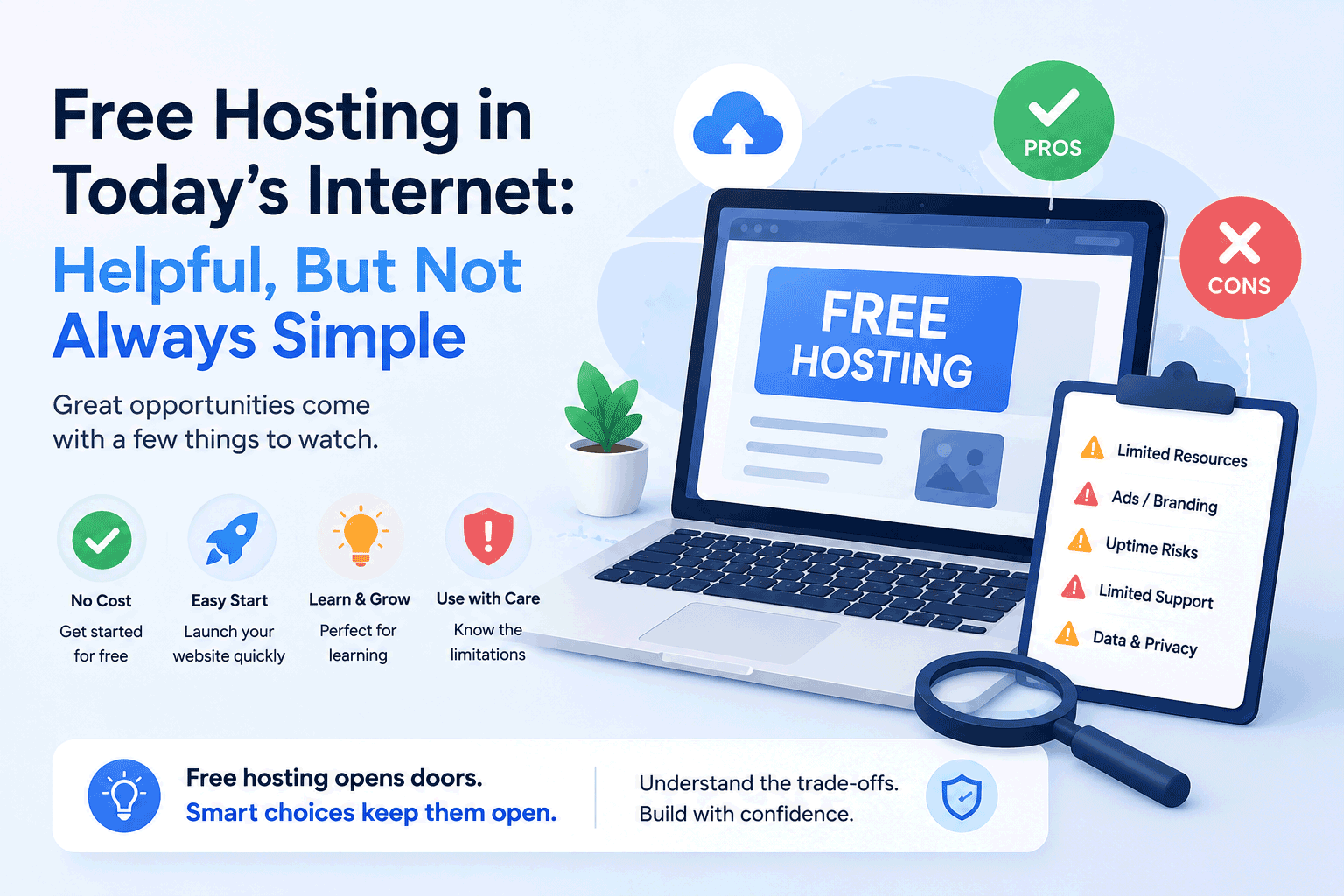
Free hosting sounds like a simple idea.
You want to build a website, you find a platform that lets you host it for free, and you publish your pages online without paying first. For beginners, students, creators, developers, and small project owners, that can be a very attractive starting point.
And in many cases, free hosting is still genuinely helpful.
It gives people the chance to learn, test, build, and publish without needing a budget from day one. It can support a personal project, a basic portfolio, a small landing page, a coding practice site, a school assignment, or an early idea that is not ready for a paid hosting plan yet.
But today’s internet is different from the internet of the past.
Free hosting is no longer just one simple category. There are now many kinds of free website platforms, each with different strengths, limits, rules, and upgrade paths. Some are excellent for static websites. Some are suitable for WordPress testing. Some are designed for developers. Some work more like website builders. Some are connected with cloud platforms, and some now include AI tools to help users create websites faster.
This gives users more freedom, but it also makes the decision less simple.
Free hosting can still be useful. But choosing the right free hosting service requires more careful thinking than before.
Why free hosting still has value
Free hosting remains valuable because it helps people start.
That first step is important. Many people have ideas for websites but delay building them because they are not sure where to begin. They may not want to pay for hosting before they understand what they need. They may be learning web development. They may be testing whether a project is worth continuing.
Free hosting helps reduce that hesitation.
It allows users to try things in a low-risk way. You can create a simple page, test a design, upload files, try WordPress, experiment with a website builder, or publish a small project without making a financial commitment.
For beginners, this can be very helpful. Reading about websites is one thing. Actually publishing one is different. Free hosting gives users a place to practice and learn by doing.
That practical experience is often more useful than waiting until everything is perfect.
The internet now has more hosting choices than ever
Years ago, free hosting usually meant a basic hosting account with limited space and a subdomain. You uploaded your files, created a few pages, and worked within the provider’s limits.
Today, users have many more options.
A free hosting solution may be:
- a traditional web hosting account
- a free WordPress hosting plan
- a static website hosting platform
- a no-code website builder
- a developer platform with Git deployment
- a cloud-based free tier
- a landing page builder
- an AI-assisted website creation tool
This variety is good, but it can also confuse beginners.
A platform may be free, but that does not mean it supports the kind of website you want to build. For example, a static hosting platform can be great for HTML, CSS, and JavaScript sites, but it will not work the same way as WordPress hosting. A website builder may be easy to use, but it may not offer the same control as traditional hosting. A developer platform may be powerful, but it may feel too technical for someone who just wants a simple personal website.
So the question is not only, “Can I host my website for free?”
A better question is:
“Which type of free hosting matches what I want to build?”
Free hosting is helpful when the purpose is clear
Free hosting works best when you know what you are trying to achieve.
If you are learning, your needs may be simple. You may only need a place to upload files, test layouts, and understand how hosting works.
If you are building a portfolio, you may care more about design, custom domain support, and presentation.
If you are testing WordPress, you need PHP, database support, enough storage, and a setup that can handle themes and plugins.
If you are creating a landing page for a new idea, you may need speed, simplicity, and a clean design.
If you are a developer, you may care about Git integration, deployment workflow, build tools, and version control.
Each use case is different.
A free host that is perfect for one person may be a poor fit for another. This is why broad recommendations can be misleading. The best free hosting option is not always the one with the most features. It is the one that fits the project’s real purpose.
The limits are part of the free model
Free hosting is not magic. Providers still need to run servers, maintain systems, manage traffic, offer tools, and support users. Since the service is free, there are usually limits somewhere.
Those limits may include storage, bandwidth, performance, support, custom domains, databases, backups, email, or the ability to remove ads and branding.
This is not always a problem. In fact, limits are expected.
The important thing is whether the limits are acceptable for your project.
For example, limited storage may be fine for a small personal page, but not for a media-heavy blog. A provider subdomain may be acceptable for testing, but not ideal for a professional brand. Limited support may be fine for someone learning, but risky for a business website. Ads may not matter on a practice site, but they can reduce trust on a public-facing page.
Free hosting can still be a good choice when users understand the trade-offs.
Problems usually happen when people only see the word “free” and do not check what comes with it.
Simple does not always mean suitable
Many free platforms are designed to make website creation easier. This is useful, especially for beginners who do not want to deal with technical setup.
But simple does not always mean suitable.
A very easy website builder may help you publish quickly, but it may limit your design control, SEO settings, export options, or ability to move your website later. A free hosting account may give more technical freedom, but it may also require more setup knowledge. A developer platform may be powerful, but it may not be friendly for someone who has never used Git before.
The easiest option today may not always be the best option tomorrow.
That is why it helps to think beyond the first setup. Ask yourself what may happen if the website grows, if you want your own domain, if you need better speed, if you want to add more content, or if you need to move to another platform later.
A good hosting choice should help you start, but it should not make your next step unnecessarily difficult.
Free hosting can be a bridge, not the final destination
One healthy way to think about free hosting is to see it as a bridge.
It can help you move from idea to action. It can help you learn the basics. It can help you test a project before investing more time or money. It can help you understand what features you actually need.
For many users, that is enough.
But if the website becomes important, the hosting decision may need to change.
A business website, online store, client project, professional blog, or growing content platform may eventually need better performance, stronger support, proper backups, security features, email support, and more control.
That does not mean starting with free hosting was wrong. It simply means the project has moved to a new stage.
Free hosting is often best for the beginning stage. Paid hosting or more advanced infrastructure may become more suitable when the website becomes more serious.
What beginners should pay attention to
For beginners, the most important thing is not to check every technical detail perfectly. The goal is to understand the basics well enough to avoid major surprises.
Before choosing a free hosting provider, it is worth checking:
- what type of website it supports
- whether ads or branding appear on your site
- whether custom domains are allowed
- whether SSL/HTTPS is included
- how much storage and bandwidth are provided
- whether database support is available
- whether WordPress is properly supported, if needed
- whether backups are included or possible
- whether you can export or migrate your website later
- what happens when you need to upgrade
These points can help you understand whether a free plan is suitable for your project or only attractive on the surface.
A few minutes of checking can save many hours of frustration later.
Free hosting and trust
Trust is another important point.
When visitors open your website, they form an impression quickly. A slow website, broken page, forced ads, long subdomain, missing HTTPS, or unreliable loading can affect how people see your project.
This may not matter much for a private test site. But it matters for a portfolio, business page, public blog, or any website you want people to take seriously.
Free hosting can still support trustworthy websites in some cases, especially when the platform is stable and the website is simple. But users should be realistic about the impression they want to create.
If your website represents your work, brand, or business, hosting becomes part of your credibility.
The role of AI and modern website tools
Another reason free hosting feels different today is the rise of AI-assisted website tools.
Some platforms can now help users create layouts, write first-draft content, generate design ideas, or build pages faster. This can be helpful for people who do not know where to start.
However, AI tools do not remove the need to understand hosting basics.
Even if a website is created quickly, users still need to know where it is hosted, what limits apply, whether they own or can export their content, how the site performs, and what upgrade options are available.
AI can speed up website creation, but hosting decisions still matter.
A beautiful website is not very useful if it is difficult to manage, slow to load, limited by hidden restrictions, or hard to move later.
Why comparison matters more now
Because there are so many types of free hosting today, comparison is more important than ever.
But comparison should not only focus on which provider offers the biggest numbers. Bigger storage, more templates, or more features do not always mean a better experience.
A useful comparison should look at the actual fit.
Who is the platform for?
What kind of website does it support best?
What are the main limits?
Is it beginner-friendly?
Is it developer-friendly?
Can it grow with the project?
Is it easy to move away later?
Does the free plan make sense, or is it mainly a teaser for upgrades?
These questions are more useful than simply ranking platforms from best to worst.
Different users need different answers.
Free hosting is not bad. Unclear expectations are the problem.
It is easy to criticize free hosting because it has limits. But that is not always fair.
Free hosting serves an important purpose. It helps people start when they are not ready to pay. It supports learning, testing, experimenting, and early-stage building. It gives access to people who may not have a budget yet.
The real problem is not free hosting itself.
The problem is unclear expectations.
If a user expects free hosting to behave like a premium business hosting plan, they may be disappointed. But if they understand that free hosting is mainly for starting, learning, testing, or small projects, it can be very useful.
The better the expectation, the better the experience.
How FreeHostsFinder wants to help
FreeHostsFinder is being rebuilt with this practical view in mind.
We understand that people looking for free hosting are not all the same. Some are complete beginners. Some are students. Some are developers. Some are creators. Some are small business owners testing an idea. Some want WordPress. Some want a static site. Some want a website builder. Some simply want to understand their options before making a decision.
Our goal is to make free and low-cost hosting easier to understand.
We want to provide helpful guides, practical comparisons, honest notes, and beginner-friendly explanations. Not just a list of providers, but useful context that helps readers decide what fits their actual needs.
Free hosting should be easier to compare, easier to understand, and easier to use with confidence.
That is the direction we are working toward.
Final thoughts
Free hosting in today’s internet is still helpful, but it is not always simple.
There are more choices, more platform types, more tools, and more ways to build websites than ever before. This gives users more opportunities, but it also means they need to make more informed decisions.
Free hosting can be a good choice for learning, testing, personal projects, simple websites, and early ideas. But it should be chosen carefully, with an understanding of its limits, trade-offs, and future upgrade path.
The best free hosting choice is not always the most popular one or the one with the biggest promise.
It is the one that fits what you want to build today and does not block where you may want to go tomorrow.
Leave a Reply
You must be logged in to post a comment.