Not every website needs a complex hosting setup.
Some websites do not need a database, login system, admin dashboard, server-side processing, or heavy backend functions. They only need to show pages clearly, load quickly, and stay available when visitors open them.
This is where static website hosting can be a very good option.
Static website hosting is popular with developers, students, designers, documentation teams, portfolio owners, and people who want a simple, fast, and low-maintenance way to publish a website online.
But for many beginners, the word “static” may sound technical or even outdated.
In reality, static websites are still very useful today. In some cases, they can be one of the smartest ways to build and host a website, especially when the website does not need complicated backend features.
So, what exactly is static website hosting, and who should use it?
Let’s explain it in a practical way.
What is a static website?
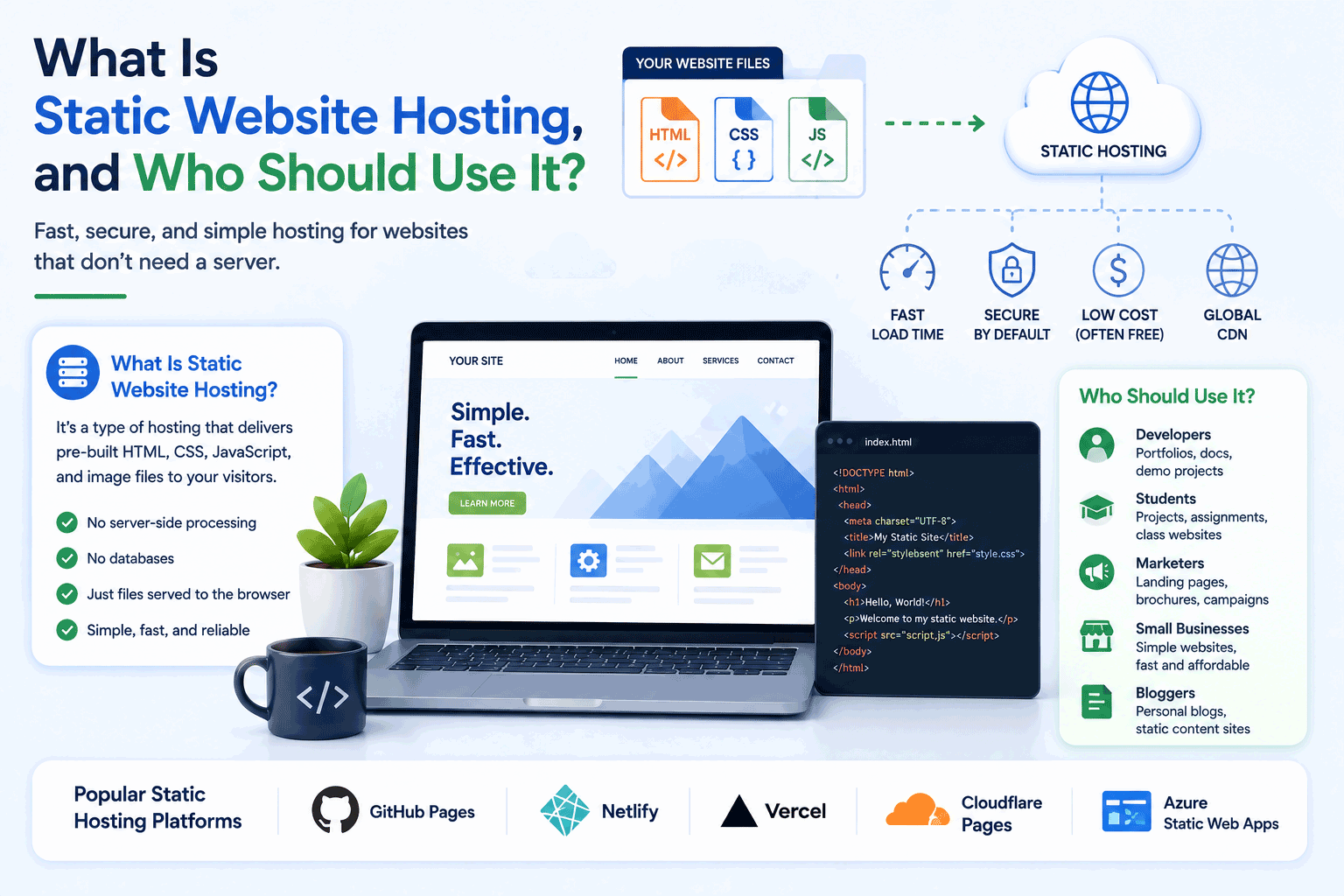
A static website is a website made from ready-made files.
These files usually include:
- HTML for page structure
- CSS for design and layout
- JavaScript for interaction
- images, fonts, icons, and other assets
When someone visits a static website, the hosting server simply sends these files to the visitor’s browser. The page is already prepared. It does not need to be built from a database every time someone opens it.
This is different from many dynamic websites.
For example, a WordPress website usually stores content in a database. When a visitor opens a page, the server processes PHP, retrieves data from the database, applies the theme, loads plugins, and then generates the final page.
A static website works more directly.
The page already exists as files, so the server can deliver it quickly.
That simple difference can make static websites fast, secure, and easier to maintain.
What is static website hosting?
Static website hosting is a hosting service designed to store and deliver static website files.
Instead of running a full server environment with PHP, databases, control panels, and backend applications, static hosting focuses on serving files efficiently.
You upload your website files, connect a domain if needed, and the platform delivers those files to visitors.
Many modern static hosting platforms also provide useful features such as:
- free SSL/HTTPS
- custom domain support
- global content delivery
- Git-based deployment
- automatic builds
- preview links
- form integrations
- simple project dashboards
This makes static hosting more modern than many beginners expect.
It is not just “basic hosting.” It can be a clean and powerful way to publish websites that do not need a traditional backend.
Why static hosting is still important today
Static hosting has become more popular again because many websites do not need to be complicated.
A personal portfolio does not always need WordPress.
A documentation site does not always need a database.
A landing page does not always need a full hosting account.
A student project does not always need server-side code.
A small information website may only need a few fast-loading pages.
When the website purpose is simple, the hosting can also be simple.
Static hosting removes many moving parts. There is no database to manage, fewer server settings to worry about, and less maintenance compared with a dynamic content management system.
This can be especially useful for beginners who want to publish a clean website without dealing with too many technical problems.
It can also be useful for developers who want a fast and modern deployment workflow.
How static hosting works in simple terms
The process is usually straightforward.
You create your website files. Then you upload them to a static hosting provider. The provider stores those files and makes them available online.
When a visitor opens your website, the platform sends the files directly to the visitor’s browser.
For a basic website, this can be very simple.
For a more modern workflow, developers may connect their hosting account to a Git repository. When they update the code and push changes, the hosting platform automatically rebuilds and publishes the website.
This is why platforms such as GitHub Pages, Netlify, Cloudflare Pages, and Vercel are popular with developers and technical users.
But static hosting is not only for advanced developers. Many simple websites can also be hosted statically with very little maintenance once they are set up.
Static websites can be very fast
One of the biggest advantages of static hosting is speed.
Because the website files are already prepared, the server does not need to process database queries or generate pages on every visit. This can make pages load very quickly.
Fast websites are better for visitors. People do not like waiting for pages to load, especially on mobile devices or slower connections.
For simple websites, static hosting can often deliver excellent performance without needing complex optimization.
This makes static hosting a strong option for:
- portfolios
- landing pages
- documentation
- simple company profiles
- personal pages
- lightweight blogs
- project pages
Speed is not only a technical benefit. It affects how people feel when they visit your website.
A fast-loading site feels more professional and easier to trust.
Static websites are often easier to secure
Static websites usually have fewer security risks than dynamic websites.
This is because there is no database login, no admin dashboard, no server-side application, and fewer backend components that can be attacked.
For example, a WordPress website needs regular updates for WordPress core, themes, and plugins. If those updates are ignored, security risks can increase.
A simple static website does not have the same kind of backend system. There are fewer parts to maintain.
This does not mean static websites are automatically perfect or impossible to attack. You still need good account security, safe deployment practices, HTTPS, and careful handling of forms or third-party scripts.
But compared with many dynamic websites, static websites can be easier to keep secure because there are fewer moving parts.
Static hosting can be low-maintenance
Many website owners do not want to spend time managing hosting.
They just want the website to stay online, load quickly, and show the right information.
Static hosting can be good for this because once the website is published, there may be very little ongoing maintenance. You do not need to manage database updates, plugin updates, CMS security patches, or server-side application errors.
For a personal portfolio or simple business profile, this can be a major advantage.
You can update the site when you need to change content, but the site itself does not require constant attention.
This is one reason static hosting is often suitable for websites that do not change every day.
Who should use static website hosting?
Static hosting is not right for every website, but it is excellent for many use cases.
Here are some common examples.
1. Portfolio websites
Static hosting is a strong fit for portfolio websites.
If you are a designer, developer, writer, photographer, freelancer, student, or professional who wants to show your work, a static website can be clean, fast, and reliable.
Most portfolios do not need a database or complex backend. They usually need pages such as:
- homepage
- about page
- project gallery
- resume or experience
- contact information
- links to social profiles
A static website can handle this very well.
If you want a polished online presence without managing WordPress or a full hosting account, static hosting can be a smart choice.
2. Student projects
Students often need a free or low-cost way to publish web projects.
For HTML, CSS, and JavaScript assignments, static hosting is usually one of the best options. It lets students publish their work online, share project links, and learn how websites behave outside a local computer.
This can be useful for:
- school assignments
- coding bootcamp projects
- front-end practice
- personal experiments
- simple app demos
- project presentations
Static hosting also teaches good habits, especially when used with Git-based platforms.
Students can learn version control, deployment, project structure, and basic web publishing in a practical way.
3. Documentation websites
Documentation websites are often a perfect match for static hosting.
Many documentation sites are mostly text, navigation, examples, screenshots, and code snippets. They do not always need a dynamic backend.
Static documentation can be fast, easy to search, easy to version, and simple to deploy.
This is why many open-source projects, developer tools, and internal teams use static site generators for documentation.
Static hosting can work very well for:
- software documentation
- product guides
- API references
- project manuals
- knowledge bases
- internal process pages
When content is mostly informational, static hosting can keep the experience fast and stable.
4. Landing pages
A landing page is usually a focused page created for one purpose.
It may promote a product, collect interest, explain a service, announce a project, or test an idea.
Static hosting can be a good option for landing pages because speed and simplicity matter. A landing page does not always need WordPress or a heavy website builder.
A static landing page can load quickly, look clean, and be easy to publish.
However, if you need forms, email capture, analytics, or payment features, you may need to connect third-party tools or use a platform that supports those integrations.
For simple campaigns or early idea testing, static hosting can be very effective.
5. Simple business websites
Some small business websites are mostly informational.
They show services, opening hours, location, contact details, images, and basic company information. If the website does not need frequent blog posts, user accounts, booking systems, or e-commerce functions, static hosting may be enough.
A static business website can be fast and low-maintenance. It can also look professional when paired with a custom domain and HTTPS.
However, businesses should think carefully about their needs.
If you need an online store, customer login, complex forms, booking management, or frequent content updates by non-technical staff, a dynamic platform or website builder may be more suitable.
Static hosting is best for business websites that are simple, clear, and not heavily interactive.
6. Developer projects and demos
Developers often use static hosting for project demos, frontend applications, open-source pages, and prototype websites.
Modern static hosting platforms can support frameworks and build tools, making them useful for more than basic HTML pages.
Developers may use static hosting for:
- React projects
- Vue projects
- front-end demos
- project documentation
- open-source project pages
- design system previews
- personal developer portfolios
With Git-based deployment, developers can update a website by pushing code to a repository. The platform then builds and publishes the latest version.
This workflow is one reason static hosting is popular in modern web development.
7. Personal websites
A personal website does not always need complex hosting.
If you want a simple online home for your bio, links, writing, photos, projects, and contact details, static hosting can be enough.
It can be cleaner and more flexible than only using social media profiles.
You can own your own space, use your own domain, and keep the website simple.
For people who want a lightweight personal presence, static hosting is worth considering.
When static hosting may not be enough
Static hosting is useful, but it is not suitable for every website.
You may need another type of hosting if your website requires:
- WordPress dashboard editing
- user accounts and login systems
- dynamic database content
- online store functions
- membership areas
- booking systems
- forums or community features
- server-side scripts
- complex form processing
- personalized user experiences
- frequent editing by non-technical users
Static websites can still connect to external tools for some of these features, but the setup may become more complex.
For example, a static site can use third-party form services, embedded calendars, payment links, or external CMS tools. But if the website depends heavily on dynamic features, traditional hosting, managed WordPress, or a web application platform may be a better fit.
The key is to match the hosting type with the website’s real needs.
Static hosting vs WordPress hosting
Static hosting and WordPress hosting serve different purposes.
WordPress is useful when you want a content management system. It gives you an admin dashboard, themes, plugins, user roles, categories, blog publishing tools, and many extensions.
Static hosting is useful when you want speed, simplicity, and fewer backend requirements.
A WordPress website is often easier for non-technical users to update regularly. A static website may require editing files, using a static site generator, or working with Git, depending on the setup.
So the better choice depends on your workflow.
Choose static hosting if you want a fast, simple, low-maintenance website and do not need a full CMS.
Choose WordPress hosting if you need regular content publishing, plugin features, dashboard editing, and more dynamic site management.
Neither is always better. They are simply built for different needs.
Static hosting vs website builders
Website builders are usually easier for complete beginners because they provide visual editing tools.
You can drag and drop sections, change text, upload images, and publish without touching code. This is useful for users who want convenience.
Static hosting usually gives more control, especially for people who can work with HTML, CSS, JavaScript, or static site generators. But it may require more technical knowledge.
A website builder is better when you want the easiest path.
Static hosting is better when you want clean files, fast loading, more technical control, and fewer platform restrictions.
For some users, a website builder will feel simpler. For others, static hosting will feel cleaner and more flexible.
The role of static site generators
Static websites do not always have to be written manually page by page.
Many people use static site generators to create websites from templates, markdown files, and structured content.
A static site generator can help build blogs, documentation, portfolios, and multi-page websites while still producing static files for hosting.
This gives users some benefits of a content system without needing a traditional database-driven platform.
However, static site generators may require more technical learning. They are often better for developers or users who are comfortable with files, commands, and deployment workflows.
For beginners, simple HTML pages may be enough at first.
What to check before choosing static hosting
Before choosing a static hosting platform, check a few important points.
First, check whether custom domains are supported. If you want a professional website, using your own domain can be important.
Second, check whether SSL/HTTPS is included. Most modern hosting platforms provide this, but it is still worth confirming.
Third, check deployment options. Some platforms allow direct uploads, while others are designed around Git repositories.
Fourth, check bandwidth and build limits. Free plans may have limits on traffic, builds, storage, or team features.
Fifth, check whether the platform supports the framework or tools you want to use.
Finally, check how easy it is to move your site later. Static websites are often easier to migrate because they are just files, but platform-specific settings should still be considered.
Common mistakes with static hosting
One common mistake is choosing static hosting for a website that actually needs dynamic features.
If you need WordPress, user accounts, database content, or online store functionality, static hosting may not be the easiest path.
Another mistake is assuming static websites cannot look modern. This is not true. Static websites can be beautifully designed, interactive, responsive, and professional.
A third mistake is ignoring forms. Static sites do not process forms by themselves unless connected to a service or backend function. If you need contact forms, newsletter sign-ups, or submissions, make sure your hosting platform or third-party tool supports it.
Another mistake is choosing a technical platform when you are not comfortable with the workflow. Some static hosting platforms are beginner-friendly, while others are more developer-focused.
The best option depends on your skill level.
Benefits of static website hosting
Static hosting can offer several clear benefits:
- fast page loading
- simple structure
- fewer backend security concerns
- lower maintenance
- good fit for free hosting plans
- easy deployment for developers
- strong fit for portfolios and landing pages
- easier migration in many cases
- suitable for lightweight websites
- good performance for global visitors when CDN is included
These benefits make static hosting a strong choice when your website does not need complex backend features.
Limitations of static website hosting
Static hosting also has limitations:
- no built-in database
- no native WordPress dashboard
- no server-side processing by default
- forms may need third-party tools
- content updates may require editing files
- may be less convenient for non-technical users
- advanced dynamic features may need extra services
- not ideal for large interactive platforms
These limitations are not necessarily problems. They simply define what static hosting is best for.
A static website can be excellent when the website purpose fits the model.
Is static hosting good for beginners?
Static hosting can be good for beginners, depending on the beginner.
If someone wants to learn HTML, CSS, and JavaScript, static hosting is one of the best ways to practice. It teaches the basics clearly and gives a real publishing experience.
If someone wants to build a website without touching code, a website builder may be easier.
So the answer depends on the learning goal.
For coding beginners, static hosting is very useful.
For non-technical beginners, a no-code website builder may be more comfortable.
For WordPress beginners, free WordPress hosting may be more relevant.
Static hosting is beginner-friendly when it matches what the beginner wants to learn.
How FreeHostsFinder wants to help
At FreeHostsFinder, we want to help users understand that free hosting is not only one thing.
Static website hosting is one of the most useful categories today, especially for portfolios, student projects, documentation, landing pages, and frontend development.
But it is not the right answer for every website.
Our goal is to help readers compare hosting types in a practical way. Instead of only asking which provider is free, we want to help users understand which hosting style fits their website purpose.
A good hosting choice should make your website easier to build, easier to maintain, and easier to grow in the right direction.
Final thoughts
Static website hosting is a simple but powerful way to publish websites.
It works especially well for websites that do not need a database or complex backend features. If you are building a portfolio, student project, documentation site, landing page, personal website, or frontend demo, static hosting can be fast, clean, and low-maintenance.
But if your website needs WordPress, user accounts, online store features, dynamic content, or frequent editing through a dashboard, static hosting may not be the best fit.
The best hosting choice always depends on what you want to build.
Static hosting is not old-fashioned. It is one of the most practical options for many modern websites.
If your website is simple, content-focused, and does not need heavy backend features, static hosting may be exactly what you need.
Leave a Reply
You must be logged in to post a comment.