WordPress is one of the most popular ways to build a website, especially for blogs, personal sites, small business pages, portfolios, and content-focused projects.
For many beginners, the idea of free WordPress hosting sounds very attractive. You can try WordPress, publish a website, test themes, write posts, and learn how everything works without paying for hosting first.
That can be a very useful starting point.
But WordPress is different from a simple static website. It needs more resources, more maintenance, and a proper hosting environment to run smoothly. Because of that, free WordPress hosting can be helpful in some situations, but limiting in others.
So the real question is not only:
“Can I host WordPress for free?”
A better question is:
“Is free WordPress hosting the right place for the kind of website I want to build?”
Let’s look at it carefully.
Why free WordPress hosting is attractive
The biggest benefit of free WordPress hosting is obvious: it lets you start without paying first.
For beginners, this matters. Many people want to try WordPress before spending money on hosting, themes, plugins, or a domain name. They may not know yet whether they want to build a blog, a business website, a personal portfolio, or just practice using WordPress.
Free hosting gives them a low-risk place to explore.
You can learn how the WordPress dashboard works. You can create pages, publish posts, test basic themes, understand menus, upload images, and get familiar with settings. If you are completely new, this learning experience can be valuable.
It is much easier to understand WordPress when you are actually using it, not only reading about it.
For this reason, free WordPress hosting can be a good first step.
WordPress needs more than basic hosting
WordPress is not just a group of simple website files. It is a dynamic content management system.
That means it usually needs PHP, a database, storage space, memory, server processing power, and regular updates. Themes, plugins, media files, and backups can also use resources quickly.
This is why WordPress hosting is more demanding than a simple HTML website.
A small static website can often run well on very lightweight hosting. WordPress, on the other hand, depends on the server every time pages are loaded, content is updated, plugins are used, or visitors interact with the site.
Free hosting may support WordPress technically, but that does not always mean it will provide the smoothest experience.
A free WordPress site may feel fine at the beginning. But after adding a few plugins, uploading images, changing themes, or receiving more visitors, limits can appear.
When free WordPress hosting makes sense
Free WordPress hosting can be useful when the website is still in the learning or testing stage.
It may be suitable if you want to:
- learn the WordPress dashboard
- test how posts and pages work
- try basic themes
- understand plugins
- create a small practice blog
- build a temporary demo site
- compare WordPress with website builders
- prepare a simple draft before moving later
In these cases, you may not need strong performance, advanced support, or a professional setup.
Your goal is mainly to learn and experiment. If something breaks, you can fix it, rebuild it, or start again without serious impact.
For learning, free WordPress hosting can be very useful.
When free WordPress hosting may become limiting
Free WordPress hosting becomes more difficult when your website starts to matter.
If the site represents your business, receives real visitors, supports your personal brand, or contains content you care about, the limits of free hosting may become more noticeable.
You may face slower loading times, limited storage, restricted plugins, database limits, fewer backup options, provider branding, no email support, or limited technical support.
These limits may not be a problem for a test site. But they can become a problem for a serious blog or business website.
WordPress is powerful because it can grow. But to grow well, it needs the right foundation.
If the hosting environment is too limited, WordPress can feel heavier, slower, and harder to manage than it should.
Plugin and theme limitations
One of the main reasons people choose WordPress is flexibility.
You can use themes to change the design. You can use plugins to add features such as contact forms, SEO tools, galleries, security, analytics, caching, backups, and more.
But free WordPress hosting may not always give you full freedom.
Some platforms may restrict which plugins you can install. Some may not allow custom themes. Some may limit uploads, editing access, PHP settings, or database access. Some may work well only with basic WordPress usage.
This is important because WordPress without flexibility may not feel like the WordPress experience users expect.
If you only want to learn the basics, limited features may be acceptable. But if you want to build a customized website, plugin and theme limitations can become frustrating.
Before choosing free WordPress hosting, check whether you can install the themes and plugins you actually need.
Storage can run out faster than expected
Many beginners underestimate how much storage WordPress can use.
At first, your website may only have a few pages and images. But as you add posts, upload media, install themes, add plugins, and create backups, storage usage can grow quickly.
Images are often the biggest storage issue. A blog with many photos, screenshots, or graphics can use space much faster than expected.
Some free hosting plans offer very limited storage. This may be fine for testing, but not ideal for a growing content website.
If your website will include many images, downloadable files, or frequent blog posts, storage should be checked carefully before you start.
Running out of storage can interrupt your workflow and force you to upgrade or migrate earlier than planned.
Performance matters more for WordPress
Website speed is important for every site, but it is especially important for WordPress.
A slow WordPress website can make the dashboard difficult to use and can also frustrate visitors. Pages may take longer to load, images may appear slowly, and the site may feel less reliable.
Free hosting often uses shared resources. This means many websites may be using the same server environment. If resources are limited, WordPress performance can suffer.
Performance may still be acceptable for a small practice site. But if you want to publish content seriously or bring visitors from search engines and social media, speed becomes more important.
A website that feels slow can reduce reader trust, even when the content is good.
Backups should not be ignored
Backups are one of the most important parts of running a WordPress website.
WordPress sites can break for many reasons. A plugin update may cause an issue. A theme change may affect the design. A setting may be changed by mistake. A website may be affected by security problems or accidental deletion.
Without a backup, recovering the site can be difficult.
Some free WordPress hosting plans may not include automatic backups. Others may provide backups only in paid plans. Some may allow manual backups, but the process may require more technical effort.
If your site is only for practice, this may not matter too much. But if your content is important, backups are essential.
Even if the hosting is free, your time and content still have value.
Migration can be the hidden challenge
One of the biggest questions with free WordPress hosting is:
Can you move your website later?
At the beginning, many users do not think about migration. They only want to start quickly. But if the website grows, they may later want better hosting, a custom domain, stronger performance, or more control.
If migration is difficult, the free hosting choice can become a problem.
For WordPress, migration usually involves website files, media uploads, themes, plugins, and the database. If you cannot access or export these properly, moving to another host may be harder than expected.
This is why it is wise to check migration options before building too much content.
A good free WordPress hosting option should not trap your website.
WordPress.com and self-hosted WordPress are not the same
Beginners often feel confused about WordPress because there are different ways to use it.
A hosted WordPress platform can let you create a website without managing hosting directly. This is easier for beginners, but the free plan may come with restrictions.
Self-hosted WordPress gives more control, but it requires hosting that supports WordPress properly. This can offer more flexibility, but it also means you are responsible for more setup, maintenance, backups, and security.
Both approaches can be useful, but they are not the same.
If you want simplicity, a hosted WordPress platform may be easier.
If you want control, self-hosted WordPress is usually more flexible.
If you want to learn deeply, testing both can help you understand the difference.
The best choice depends on your goal.
Free WordPress hosting for blogs
If your goal is to start a personal blog, free WordPress hosting can be a good way to test your writing idea.
You can publish a few posts, try categories, adjust the design, and see whether you enjoy blogging before paying for hosting.
But if you want to grow the blog seriously, you should think ahead.
A growing blog may need better performance, SEO tools, custom domain support, image optimization, backups, analytics, and more design flexibility. Some of these features may be limited on free plans.
For a personal learning blog, free hosting can be enough.
For a long-term content project, you may eventually need a stronger hosting plan.
Free WordPress hosting for business websites
For business websites, free WordPress hosting should be used carefully.
A business website needs to create trust. Visitors may check your services, contact details, portfolio, prices, location, or company information. If the website is slow, shows unwanted branding, lacks a custom domain, or feels unstable, it can affect your business image.
Free hosting may be acceptable for an early draft, internal test, or temporary concept. But for a public business website, paid hosting is often more suitable.
A business website does not always need expensive hosting. But it should have a reliable foundation.
If the website helps customers decide whether to contact you, hosting quality becomes part of your credibility.
Free WordPress hosting for learning
Learning is where free WordPress hosting can shine.
If you are new to WordPress, there is no need to buy hosting immediately just to understand the basics.
You can use a free option to learn how to create posts, manage pages, change themes, install simple plugins, work with menus, adjust settings, and understand the general structure of a WordPress website.
This kind of hands-on learning is valuable.
The key is to treat the free site as a practice environment. Do not expect it to behave like a high-performance business website. Use it to learn, test, and build confidence.
When your needs become clearer, you can decide whether upgrading makes sense.
What to check before choosing free WordPress hosting
Before choosing a free WordPress hosting provider, check the details carefully.
Important points include:
- whether WordPress is truly supported
- PHP and database availability
- storage limits
- bandwidth limits
- plugin and theme restrictions
- SSL/HTTPS support
- custom domain support
- backup options
- migration options
- ads or provider branding
- support availability
- upgrade pricing
- account usage rules
You do not need every advanced feature from day one. But you should understand the limits before spending time building your website.
The more serious your website is, the more carefully you should check.
Signs that free WordPress hosting is no longer enough
You may need to upgrade when:
- your site loads slowly
- storage is almost full
- you need a custom domain
- you want to remove ads or branding
- you need more plugins or themes
- you want better backups
- your traffic is growing
- you need better support
- you are using the site for business
- you care about long-term SEO
- migration becomes a concern
- you want more control over your website
These signs do not mean free hosting was a bad choice. They simply mean your website has moved to a new stage.
A free start can still be a good start.
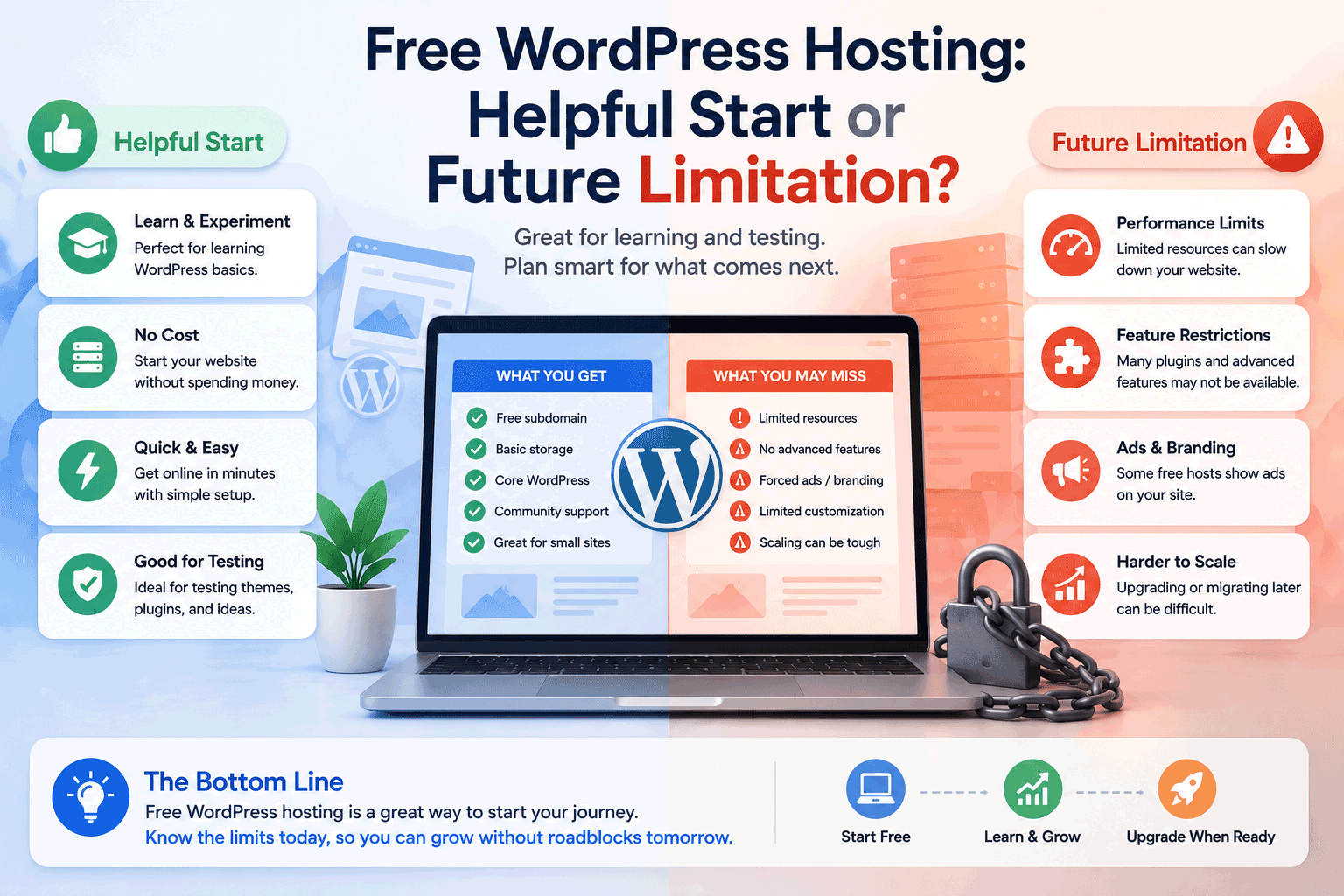
Helpful start or future limitation?
Free WordPress hosting can be both.
It is a helpful start when you are learning, testing, experimenting, or building something small. It gives you a chance to understand WordPress without paying first.
But it can become a future limitation when your site needs better performance, more control, stronger backups, custom domain support, plugin flexibility, or professional reliability.
The difference depends on your purpose.
If your goal is learning, free WordPress hosting can be a smart choice.
If your goal is building a serious long-term website, you should look carefully at the limits and upgrade path.
Free WordPress hosting is not the problem. Unclear expectations are the problem.
How FreeHostsFinder wants to help
At FreeHostsFinder, we want to help users understand hosting choices in a practical way.
Free WordPress hosting can be useful, but beginners should know what they are choosing. A plan that is good for practice may not be good for a business site. A platform that is easy to start may not be easy to migrate from later. A free plan that looks simple may hide important restrictions.
Our goal is to make these differences easier to understand.
We want to help readers compare options, check limitations, understand upgrade paths, and choose hosting based on real website needs.
Not every beginner needs paid hosting on day one. But every beginner deserves to know what they are getting.
Final thoughts
Free WordPress hosting can be a good way to begin.
It allows you to learn WordPress, test ideas, publish small projects, and explore website building without upfront cost. For beginners, students, hobby bloggers, and people testing a concept, it can be very useful.
But WordPress needs the right environment to perform well. As your website grows, free hosting may start to feel limited.
Before choosing free WordPress hosting, think about your real purpose. Are you learning, testing, blogging, building a portfolio, or preparing a business website? Do you need plugins, themes, backups, speed, a custom domain, or migration options?
The right answer depends on your stage.
Free WordPress hosting can help you start. Just make sure it does not quietly limit where you want to go next.
Leave a Reply
You must be logged in to post a comment.