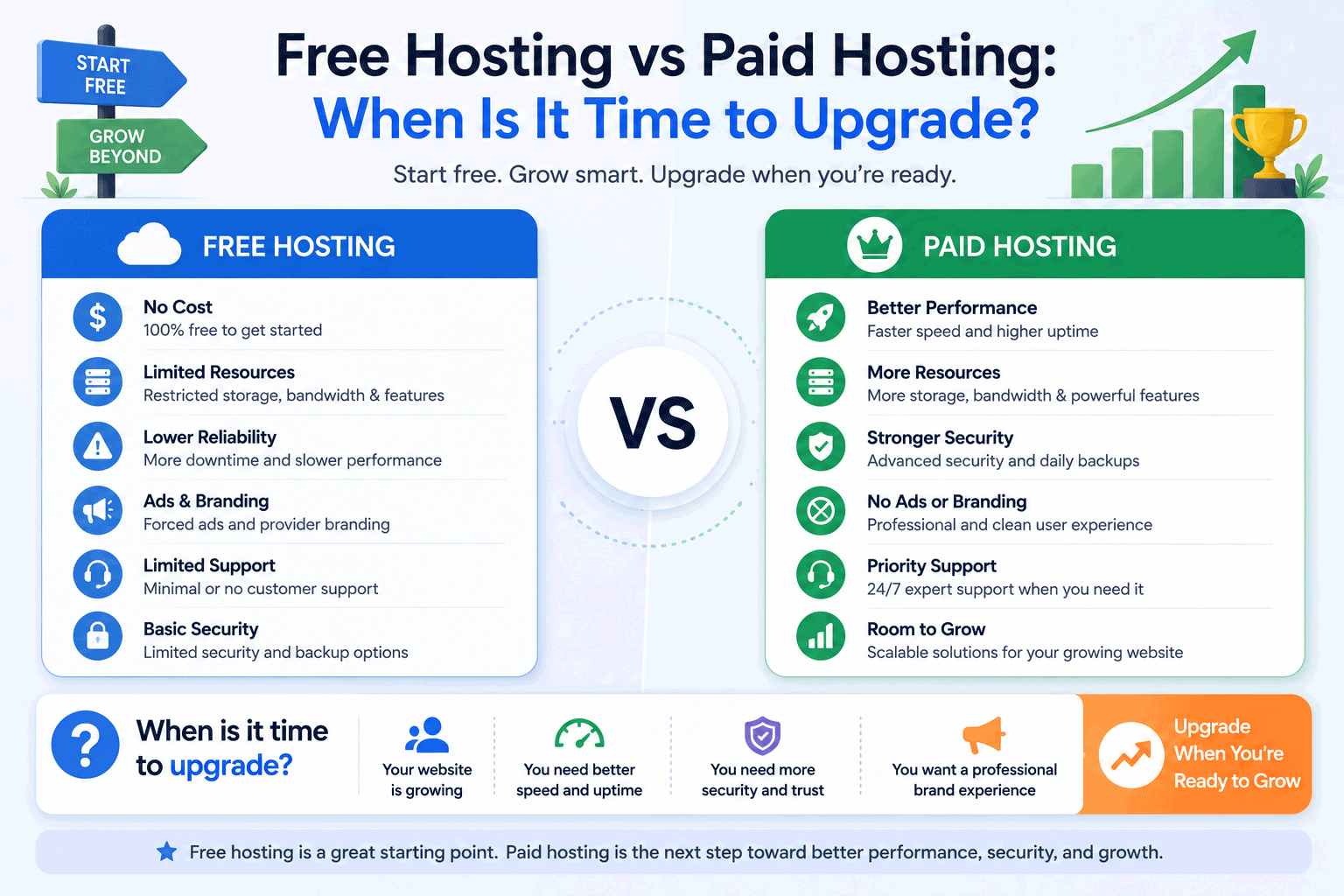
Free hosting is a helpful starting point for many website owners.
It lets you test an idea, learn how hosting works, build a small website, practice WordPress, publish a student project, or create a simple online presence without paying first. For beginners, this can be a very good way to start.
But free hosting is not always meant to support every website forever.
At some point, your website may become more serious. You may receive more visitors, publish more content, need better speed, want a custom domain, remove ads, or build more trust with your audience. When that happens, free hosting may start to feel limiting.
This does not mean free hosting is bad. It simply means your website may have reached a new stage.
So, how do you know when it is time to upgrade from free hosting to paid hosting?
Let’s look at the signs in a practical way.
Free hosting is good for starting, testing, and learning
Free hosting works best when the website is still in an early stage.
If you are learning how websites work, trying a small idea, testing a layout, practicing with WordPress, or publishing a simple project, free hosting may be enough.
In this stage, your main goal is usually not maximum performance or full control. Your goal is to get something online, understand the process, and learn what you actually need.
Free hosting can help you do that with low risk.
It gives you time to experiment before spending money. You can test the platform, understand your website structure, and decide whether the project is worth developing further.
For many people, this is the right way to begin.
Paid hosting becomes important when the website starts to matter
The need for paid hosting usually appears when your website becomes more important to you or to other people.
Maybe it now represents your business. Maybe you are sharing it with customers. Maybe you are using it as a portfolio for job applications. Maybe your blog is getting visitors. Maybe your project is no longer just a test.
When a website starts to matter, the hosting behind it matters too.
Visitors may not know what hosting plan you use, but they will notice if the website loads slowly, looks unprofessional, goes offline, shows unwanted ads, or feels unreliable.
Paid hosting is not only about buying more server resources. It is often about getting more control, more stability, more credibility, and more room to grow.
1. Upgrade when you need a custom domain
A custom domain is one of the clearest signs that your website is becoming more serious.
Instead of using a free subdomain like yourname.provider.com, a custom domain allows you to use your own address, such as yourname.com, yourbrand.com, or yourproject.com.
For learning and testing, a free subdomain may be fine. But for a public website, portfolio, blog, or business page, a custom domain usually looks more professional and easier to remember.
Some free hosting providers allow custom domains, but many reserve this feature for paid plans.
If you want people to take your website more seriously, upgrading for custom domain support can be worth it.
A custom domain also gives you more ownership over your online identity. Even if you change hosting providers later, your domain can stay with you.
2. Upgrade when ads or branding affect your website image
Some free hosting services show ads, banners, popups, or provider branding on your website.
This is understandable because free services need a way to support their operating costs. But for your visitors, those ads can affect the way they see your website.
For a practice project, ads may not matter. For a business website, professional portfolio, personal brand, or client-facing page, they can be a problem.
Unwanted ads can make a website feel less trustworthy. Provider branding can make the site feel temporary or less professional. Popups may distract visitors from your own message.
If your website represents your work, your service, or your brand, removing forced ads and branding is a strong reason to upgrade.
3. Upgrade when your website loads too slowly
Website speed matters.
If your site takes too long to load, visitors may leave before reading anything. Slow speed can also make your website feel outdated, even if the design is good.
Free hosting plans often share limited resources across many users. This can sometimes lead to slower performance, especially during busy periods or when your website grows.
If your website is only for learning, slow loading may be acceptable. But if you want visitors to stay, read, contact you, or trust your content, speed becomes more important.
You should consider upgrading when:
- pages take too long to open
- images load slowly
- WordPress dashboard feels heavy
- visitors complain about performance
- your site becomes slower after adding content
- your website traffic starts growing
A faster hosting plan can improve the visitor experience and make the site feel more reliable.
4. Upgrade when storage limits become too small
Free hosting usually comes with limited storage.
At first, this may not be a problem. A small website with a few pages and images may not need much space. But over time, storage can fill up faster than expected.
This is especially true for WordPress websites. Themes, plugins, media uploads, backups, and database files can all use storage. If you publish blog posts with many images, the storage limit may become restrictive.
When you start deleting files just to keep the website running, it may be time to upgrade.
A paid plan can give you more room to publish content, store media, install tools, and maintain backups without constantly worrying about space.
5. Upgrade when bandwidth limits hold you back
Bandwidth controls how much data your website can deliver to visitors.
If your free plan has a monthly bandwidth limit, your website may slow down or become unavailable when traffic increases. This can be frustrating if your post gets shared, your portfolio receives attention, or your campaign page starts attracting visitors.
A website does not need to be huge to use bandwidth. Large images, downloadable files, embedded media, and repeated visits can all increase usage.
If you are afraid to share your own website because it may exceed limits, that is a sign that free hosting is holding you back.
Paid hosting usually gives more bandwidth, more predictable usage, and better ability to handle traffic.
6. Upgrade when you need better support
Support may not feel important until something goes wrong.
With free hosting, support is often limited. You may only get access to documentation, community forums, or slow-response help channels. For a learning project, that may be acceptable.
But if your website is important, waiting too long for help can become a real problem.
If your site breaks, goes offline, loses data, has a security issue, or faces a technical problem you cannot solve, proper support matters.
You should consider upgrading when you need faster responses, clearer assistance, or more dependable help from the provider.
For business and professional websites, support is part of reliability.
7. Upgrade when backups become important
Backups are easy to ignore until you need them.
If your website is small and experimental, losing it may not be a major issue. But once you spend time writing content, uploading media, customizing a design, or receiving visitors, your website becomes valuable.
Free hosting may not include automatic backups. Some providers only offer backup tools on paid plans. Others leave everything to the user.
If you would be upset to lose your website, you should have a backup plan.
Upgrading to a hosting plan with backup features can protect your time and content. This is especially important for WordPress sites, where plugin updates, theme changes, or user mistakes can sometimes break the website.
8. Upgrade when security becomes a concern
Security matters more when your website becomes public, handles forms, collects inquiries, uses WordPress, or represents a business.
Free hosting may include basic security, but it may not provide all the protections you need. Some free plans may have limited SSL options, fewer security controls, restricted backup access, or less support when problems happen.
If your website collects contact form submissions, customer inquiries, user data, or login information, you should take security more seriously.
Paid hosting can often provide better security tools, SSL support, malware scanning, firewalls, backup options, and support. The exact features depend on the provider, but the key point is simple:
When trust and data matter, hosting quality matters too.
9. Upgrade when you need email with your domain
A professional email address can make your website feel more credible.
For example, contact@yourdomain.com often looks more professional than using a generic email address for a business or brand.
Many free hosting plans do not include email hosting. Some may offer limited email forwarding, while others require paid upgrades.
If your website is connected to a business, organization, service, or professional portfolio, domain-based email may be worth considering.
Paid hosting or dedicated email services can help you create a more complete and trustworthy online presence.
10. Upgrade when you need more control
Free hosting often limits what you can change.
You may not have full access to server settings, advanced configurations, databases, plugins, themes, scripts, cron jobs, email settings, or performance tools.
These limits may not matter at the beginning. But they can become frustrating when your website grows or your requirements become more specific.
For example, you may want to install a certain WordPress plugin, adjust PHP settings, use a custom script, create staging environments, run scheduled tasks, or manage database access more freely.
If you keep reaching platform limits, it may be time to move to a paid plan.
More control can help you build the website the way you actually want.
11. Upgrade when your website is part of your business
A business website should create trust.
Even if it is simple, it should load properly, use a clean domain, avoid forced ads, look professional, and stay available when customers visit.
Free hosting may be acceptable for testing a business idea, but it is not always the best long-term choice for a business-facing website.
If your website supports sales, customer inquiries, service information, booking, product pages, or company credibility, paid hosting is usually a better investment.
The monthly cost of hosting may be small compared with the value of looking professional and staying reliable.
For business use, hosting should not be treated only as a cost. It is part of your online foundation.
12. Upgrade when your content is growing
A website often starts small.
Maybe you begin with one homepage, a few images, and a contact section. Later, you add blog posts, service pages, case studies, product information, tutorials, downloads, galleries, or customer resources.
As the content grows, the hosting requirement grows too.
You may need more storage, better database performance, stronger organization, backups, and faster loading.
If your website is becoming a serious content platform, free hosting may no longer be enough.
A growing website needs a hosting environment that can grow with it.
13. Upgrade when you care about visitor trust
Trust is not only built through good writing or design. It is also affected by the technical experience.
Visitors may lose confidence if:
- the website loads slowly
- the address looks temporary
- ads appear unexpectedly
- the site is not secure
- pages break often
- forms do not work
- the website goes offline
Most visitors will not blame the hosting provider. They will simply judge the website.
If you want your site to feel trustworthy, reliable hosting becomes important.
This is one of the clearest reasons to move from free hosting to paid hosting.
14. Upgrade when migration becomes harder to delay
One mistake many website owners make is waiting too long to move.
At the beginning, migration is usually simple because the website is small. But after months of adding content, images, plugins, pages, and settings, moving can become more complicated.
If you already know your website will need better hosting later, it may be smarter to upgrade before the site becomes too large.
This is especially true for WordPress websites and business sites.
Moving early can reduce the risk of broken links, missing files, database issues, SEO disruption, or long downtime.
Free hosting is a good place to start, but staying too long on the wrong platform can make the next step harder.
15. Upgrade when your free hosting limits your confidence
This point is less technical but still important.
If you hesitate to share your website because it feels too slow, too limited, too unprofessional, or too temporary, that is a sign.
Your hosting should give you confidence to publish, share, promote, and grow.
If the free plan makes you feel unsure about your own website, upgrading may help you move forward with more confidence.
Sometimes the right upgrade is not about one specific feature. It is about removing the friction that stops you from taking your website seriously.
Free hosting vs paid hosting: a simple comparison
| Area | Free Hosting | Paid Hosting |
|---|---|---|
| Cost | No upfront hosting cost | Monthly or yearly fee |
| Best for | Learning, testing, small projects | Serious, growing, or professional websites |
| Domain | Often uses provider subdomain | Usually supports custom domains |
| Ads/Branding | May include ads or branding | Usually removable or not included |
| Performance | Can be limited | Usually better and more stable |
| Storage | Often limited | More storage options |
| Bandwidth | May have strict limits | Higher or more flexible limits |
| Support | Often limited | Usually better support |
| Backups | May be limited or unavailable | More backup options |
| Control | Restricted settings | More configuration freedom |
| Trust | Good for testing, may look temporary | Better for professional presence |
This comparison does not mean paid hosting is always required. It simply shows why paid hosting becomes more suitable when a website moves beyond the early stage.
When you may not need to upgrade yet
Not every website needs paid hosting immediately.
You may be fine staying on free hosting if:
- you are still learning
- the website is only for practice
- the project is temporary
- traffic is very low
- you do not need a custom domain
- ads or branding do not matter
- performance is acceptable
- you are not storing important content
- you can easily move later
There is no need to pay before your website needs it.
The goal is not to upgrade as soon as possible. The goal is to upgrade at the right time.
How to choose the right paid hosting when you are ready
When you decide to upgrade, do not choose only based on price.
Look at what your website actually needs.
For a WordPress website, check WordPress performance, database resources, plugin support, backups, security, and migration tools.
For a static website, you may not need traditional hosting. A paid static hosting or website builder plan may be enough.
For a business website, check custom domain support, SSL, email options, uptime, support, backups, and ease of management.
For a developer project, check the technology stack, deployment method, usage limits, scalability, and pricing after the free tier.
The best paid hosting plan is not always the most expensive one. It is the one that removes the limits that matter most to your project.
Think of upgrading as a stage, not a failure
Some beginners feel that moving from free hosting to paid hosting means the free choice was wrong.
That is not true.
Free hosting can be the right choice for the beginning. Paid hosting can be the right choice for the next stage.
A website can grow through different phases. It may start as a test, become a personal project, turn into a portfolio, grow into a blog, or become part of a business.
Your hosting should change when your website changes.
Upgrading is not a failure. It is a sign that your project has become more important.
Final thoughts
Free hosting and paid hosting both have value.
Free hosting is useful when you are starting, learning, testing, or building something small. It lowers the barrier and gives you room to explore without paying first.
Paid hosting becomes more important when your website needs trust, speed, control, support, backups, security, custom domains, and room to grow.
The best time to upgrade is not the same for everyone. It depends on your website purpose, visitors, content, technical needs, and future plans.
A simple way to decide is this:
If your website is still an experiment, free hosting may be enough.
If your website now represents your work, brand, business, or long-term project, it may be time to upgrade.
Leave a Reply
You must be logged in to post a comment.