Free web hosting can be a very useful starting point when you want to build a website without paying first.
It can help you test an idea, learn how websites work, publish a small project, create a personal portfolio, practice WordPress, or try a simple landing page before moving to something more serious.
But free hosting can also create problems when it is chosen too quickly.
Many beginners see the word “free” and immediately sign up without checking whether the platform is suitable for their website. At first, everything may look fine. But later, they may discover ads, storage limits, slow performance, missing features, weak support, or migration problems.
The issue is not that free hosting is bad. The issue is choosing it without understanding what you are getting.
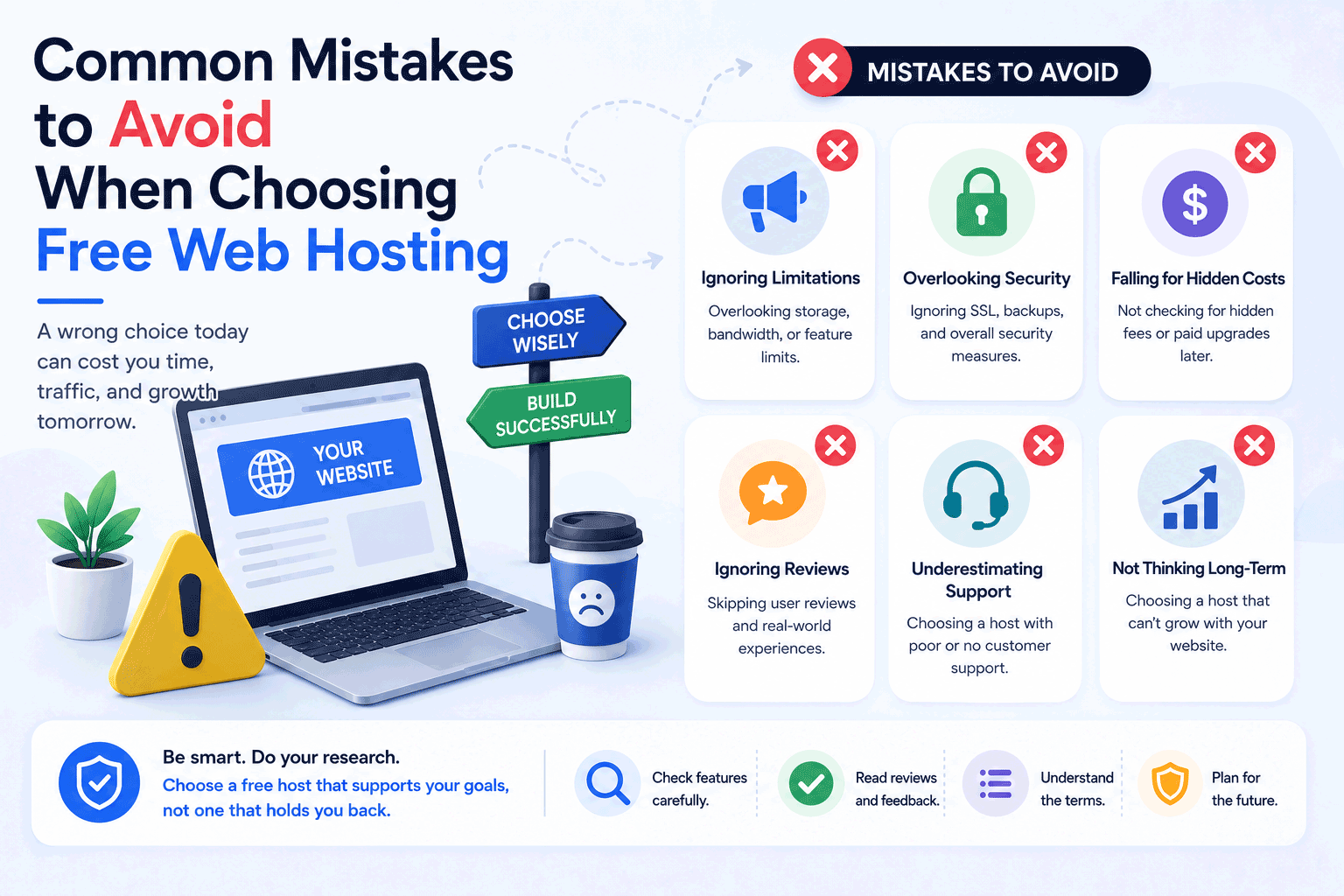
Here are some common mistakes to avoid before choosing free web hosting.
1. Choosing only because it is free
This is the most common mistake.
Free hosting is attractive because it removes the cost of starting. But a hosting plan should not be selected only because it is free. It should be selected because it fits what you want to build.
A free hosting service may be fine for a simple test website, but not suitable for a business page. It may work well for a static website, but not for WordPress. It may be good for learning, but not reliable enough for visitors.
Before choosing any free host, ask yourself one simple question:
Is this free hosting suitable for my website purpose?
If the answer is unclear, it is better to check more before signing up.
2. Not knowing what type of website you are building
Not all websites need the same type of hosting.
A static HTML website, a WordPress blog, a portfolio, a landing page, a PHP project, and a no-code website all have different requirements.
Some free hosts are designed for static websites. Some support PHP and MySQL. Some are built around WordPress. Some are website builders where you do not manage hosting directly. Some are more developer-focused and require Git or deployment settings.
If you choose the wrong type of platform, you may feel stuck later.
For example, if you want to use WordPress, a static hosting platform will not be enough. If you only need a simple portfolio, a full WordPress setup may be more complicated than necessary. If you are learning PHP and databases, a no-code website builder may not help much.
Start with the website type first. Then choose hosting that matches it.
3. Ignoring ads and forced branding
Some free hosting providers place ads, banners, popups, or branding on your website.
This may be acceptable for a personal test page or learning project. But if you are creating a portfolio, business website, public blog, or anything connected to your personal brand, forced ads can reduce trust.
Visitors may not know that the ads come from your hosting provider. They may simply feel that your website looks less professional.
This is especially important if your site is meant to impress clients, employers, customers, or business partners.
Before choosing a free host, check whether ads or provider branding will appear on your website. If they do, decide whether that is acceptable for your purpose.
4. Forgetting to check custom domain support
A free subdomain can be useful when you are just testing.
For example, a website address like yourproject.provider.com may be enough for learning or sharing with classmates. But if you want a more professional presence, you will likely need your own custom domain.
Many free hosting plans either do not support custom domains or only support them after upgrading to a paid plan.
This is not always a problem, but it is something you should know before building your website.
If your website may become more serious later, custom domain support matters. It helps you build a clearer identity and makes it easier for visitors to remember your website.
A good free hosting option should either support custom domains or offer a clear upgrade path when you are ready.
5. Assuming unlimited really means unlimited
Some hosting plans use attractive words like “unlimited storage” or “unlimited bandwidth.”
Be careful with this.
In real hosting environments, resources are never truly unlimited. There are usually fair usage rules, CPU limits, file limits, traffic policies, or account restrictions behind the scenes.
This does not mean every provider using the word “unlimited” is bad. But it does mean you should read the conditions more carefully.
For a small website, this may not matter. But if you plan to upload many files, use many images, or receive more visitors, hidden limits can become important.
Do not rely only on marketing words. Look for the actual usage rules.
6. Not checking storage limits
Storage may not seem important when your website is new.
A few pages and images may not use much space. But over time, storage can fill up quickly, especially if you use WordPress, upload many images, install themes and plugins, or keep backups.
Some free hosts provide only a small amount of storage. Others may limit file sizes, media uploads, or certain file types.
If your website is only a simple static page, limited storage may be fine. But if you plan to publish regularly or use media-heavy content, storage should be checked carefully.
Running out of space can stop your website growth earlier than expected.
7. Overlooking bandwidth limits
Bandwidth affects how much data your website can send to visitors.
If your website receives more traffic than the free plan allows, it may slow down, stop loading, or require an upgrade.
Many beginners do not think about bandwidth because their website starts with very few visitors. But if they share the website on social media, send it to many people, or publish content that gets attention, bandwidth can become an issue.
Large images, downloads, videos, and heavy pages also use more bandwidth.
If you expect your site to be public, check bandwidth limits before choosing a host.
8. Ignoring website speed
A free host may allow you to publish a website, but that does not always mean the site will load quickly.
Speed matters because visitors are impatient. If a website loads slowly, many people leave before reading anything.
Slow speed can also make your website feel less trustworthy, even if the content is good.
Free hosting often uses shared resources. This means many websites may be running on the same infrastructure, and performance can vary.
If your project is only for practice, speed may not be your biggest concern. But if the site is for public visitors, a portfolio, or a business purpose, performance should not be ignored.
A free plan that is too slow may cost you visitors, attention, and trust.
9. Assuming WordPress will work well everywhere
WordPress is popular, but it needs the right hosting environment.
It requires PHP, a database, enough storage, enough memory, and stable server performance. Some free hosts support WordPress, but the experience may be limited. The site may become slow after installing themes and plugins. Backups may not be included. Database access may be restricted. Plugin installation may have limits.
If your goal is to learn WordPress, free hosting can be useful. But if your goal is to build a serious blog or long-term content website, you need to check WordPress compatibility carefully.
Do not assume that because a host says “WordPress supported,” it will provide a smooth WordPress experience.
10. Forgetting about backups
Backups are not exciting, but they are important.
Many beginners only think about backups after something goes wrong. A website can break because of a wrong setting, plugin conflict, failed update, accidental deletion, or account issue.
Some free hosting providers do not include automatic backups. Some include backups only on paid plans. Some expect users to manage backups manually.
Even if your website is free, your time is not free. If you spend hours building pages and writing content, losing everything can be frustrating.
Before choosing free hosting, check whether backups are available. If not, make sure you know how to create your own backup.
11. Not checking whether migration is possible
This is one of the most important mistakes.
A free hosting plan may be enough today, but your website may grow later. You may want better speed, more storage, a custom domain, fewer restrictions, or paid hosting.
If migration is difficult, you may have to rebuild your website from the beginning.
Before choosing a free host, check whether you can export your files, download your database, move your WordPress site, or transfer your content.
This matters especially for website builders and closed platforms. Some platforms make it easy to create a site but difficult to move it elsewhere.
A good starting platform should not trap your future growth.
12. Ignoring upgrade pricing
Many free hosting services are designed as entry points to paid plans.
That is not a bad thing. In fact, it can be helpful if the upgrade path is clear and fair.
The mistake is using a free plan without checking what happens when you need more features later.
Before choosing a free host, look at the paid plan prices. Check what is included in the first upgrade level. Does it remove ads? Does it allow a custom domain? Does it increase storage and bandwidth? Does it provide backups, support, or email?
A free plan may look good now, but if the upgrade path is too expensive or does not fit your needs, you may have to move later.
13. Not reading the basic usage rules
Free hosting usually has rules to prevent abuse.
There may be limits on CPU usage, scripts, file storage, traffic sources, email sending, cron jobs, content types, or inactivity periods. Some accounts may be suspended if they exceed fair usage policies or remain inactive for too long.
Most normal users will not face problems if they follow the rules. But it is still better to understand them before building.
This is especially important if your website uses scripts, forms, downloads, user-generated content, or resource-heavy features.
A free host may be suitable for a normal website but not for every kind of project.
14. Expecting strong support from a free plan
Support is often limited on free hosting plans.
You may get documentation, community forums, or basic help articles. Direct support may be slow, limited, or available only for paid users.
For a learning project, this may be acceptable. Solving small issues yourself can even be part of the learning process.
But if your website is important, limited support can become risky.
If you cannot afford downtime, broken pages, or unresolved technical issues, you should consider whether free hosting is enough.
Free hosting is best when you are comfortable with some self-service troubleshooting.
15. Choosing a platform that is too technical or too limited
A hosting platform should match your skill level.
Some free hosting platforms are powerful but technical. They may require Git, build commands, DNS settings, deployment configuration, or command-line knowledge. These can be excellent for developers, but overwhelming for beginners.
Other platforms are very simple but limited. They may be easy to use but restrict design control, export options, plugins, code access, or advanced settings.
Neither type is automatically better.
The mistake is choosing a platform that does not match how you want to work.
If you are a beginner, simplicity may matter more than advanced control. If you are a developer, flexibility may matter more than drag-and-drop convenience.
Choose based on your comfort level and project needs.
16. Ignoring security basics
Even a small website should not ignore security.
At minimum, check whether SSL/HTTPS is included. A website without HTTPS may look unsafe to visitors and browsers.
If you are using WordPress or any system with login access, security becomes even more important. You should think about updates, backups, strong passwords, plugin safety, and provider reliability.
Free hosting may include basic security, but you should not assume everything is handled for you.
Security matters more if your website has contact forms, collects information, allows logins, or represents a business.
A free website still needs responsible management.
17. Using free hosting for the wrong stage of the project
Free hosting is excellent for some stages.
It is great for learning, testing, experimenting, and small projects. It can also be useful for temporary pages or early drafts.
But when a website becomes important, the hosting needs may change.
If your website supports a business, receives real visitors, represents your brand, or contains valuable content, free hosting may not always be enough.
One mistake is staying on free hosting too long simply because it costs nothing.
The better approach is to use free hosting while it fits, then upgrade when your website needs more reliability, control, support, and trust.
18. Not thinking about visitor trust
Visitors judge a website quickly.
They may notice if the site loads slowly, shows ads, uses a long subdomain, lacks HTTPS, breaks on mobile, or looks temporary.
These details can affect trust.
For private testing, this may not matter. But for a public website, portfolio, business page, or content project, trust matters a lot.
Free hosting can still be useful, but you should think about how your visitors will experience the site.
A website is not only something you build. It is something people visit, judge, and interact with.
A simple checklist before choosing free hosting
Before choosing a free host, ask yourself:
- What type of website am I building?
- Does this host support the technology I need?
- Will ads or branding appear on my site?
- Can I use a custom domain?
- Is SSL/HTTPS included?
- Are storage and bandwidth enough?
- Is WordPress properly supported, if I need it?
- Can I back up my website?
- Can I migrate later?
- What support is available?
- What are the upgrade prices?
- Are there usage rules I should know?
- Is the platform suitable for my skill level?
- Will visitors trust the website experience?
You do not need a perfect answer for every point. But you should understand the important trade-offs before you begin.
Final thoughts
Free web hosting can be a smart choice when used for the right purpose.
It can help you start faster, learn safely, test ideas, and publish small projects without upfront cost. For many beginners, that first step is valuable.
But free hosting should not be chosen blindly.
The most common mistakes usually happen when users focus only on the word “free” and forget to check the things that affect real website use: ads, speed, storage, bandwidth, domains, backups, support, security, migration, and future upgrade options.
A free host does not need to be perfect. It only needs to fit your current goal and give you a reasonable path forward.
Leave a Reply
You must be logged in to post a comment.