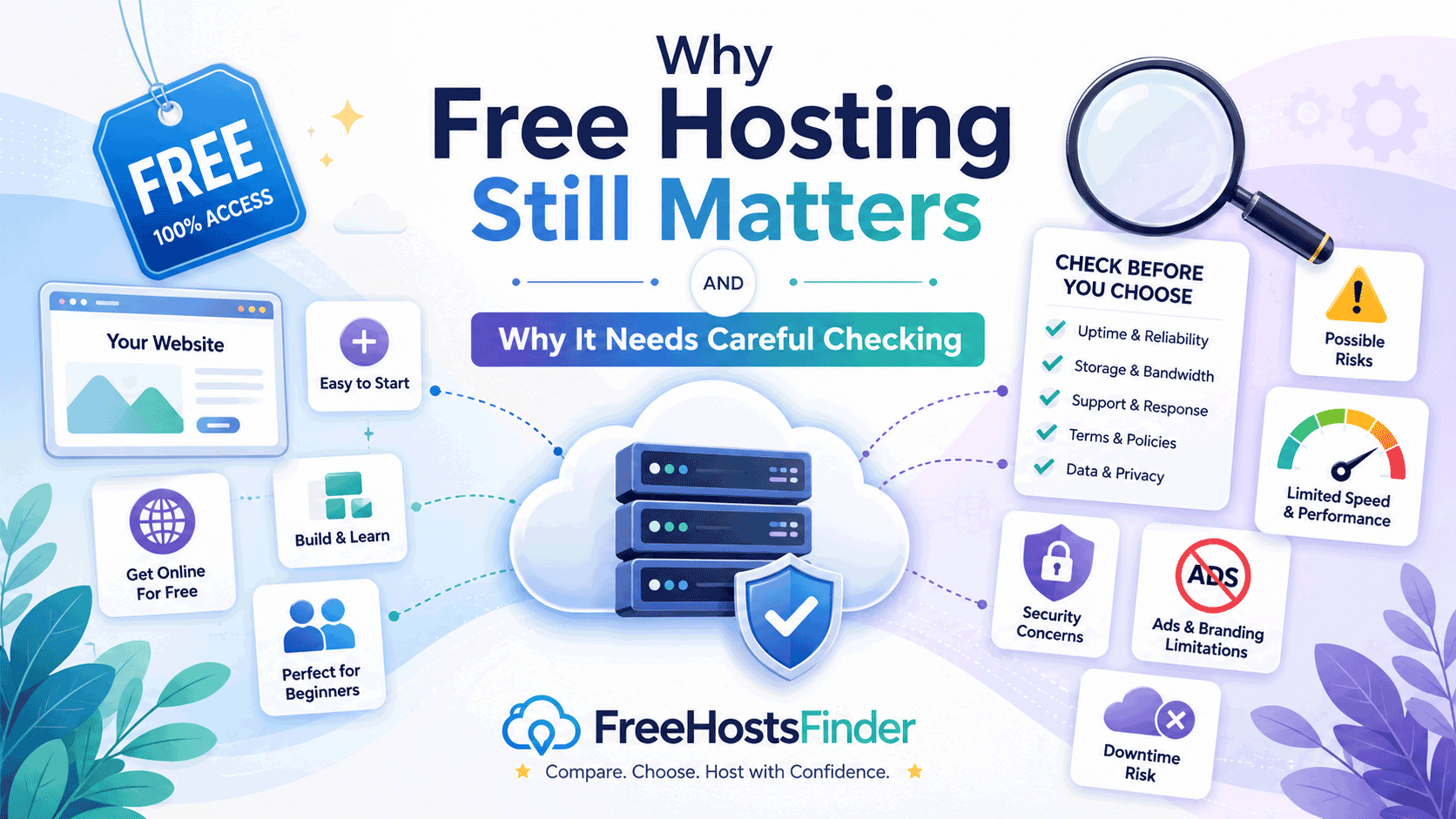
Free hosting has been around for a long time, and for many people, it is still one of the easiest ways to begin a website journey.
Not everyone starts with a budget. Some people only want to test an idea. Some are learning how websites work. Some need a simple page for a small project, a school assignment, a portfolio, a personal blog, or a temporary landing page. In those situations, free hosting can be very useful.
But today, choosing free hosting is not as simple as it used to be.
There are now many different types of platforms available. Some offer traditional free web hosting. Some focus on WordPress. Some are built for static websites. Some are website builders. Some are developer-friendly platforms, and some now include AI-assisted website creation tools.
This is good because users have more choices. But it also means users need to check more carefully before deciding where to build.
Free hosting is still useful for starting small
One reason free hosting still matters is simple: it lowers the barrier to getting online.
A beginner can try building a website without paying first. A student can practice web development. A small business owner can test a basic idea before investing in a full hosting plan. A developer can create a prototype. A creator can publish a simple page and see how it works.
For many people, the first step matters more than having a perfect setup.
Free hosting can help users move from “I want to build a website” to “I have something online.” That small step can make a big difference, especially for people who are just getting started.
It also gives users room to learn. They can understand domains, files, databases, WordPress, SSL, storage, bandwidth, website builders, control panels, and publishing workflows without needing to commit to a paid service immediately.
But “free” does not always mean simple
Free hosting can be helpful, but it is important to understand what is included and what is not.
A free plan may come with limited storage. It may have bandwidth limits. It may show ads on your website. It may not support a custom domain. It may have slower performance. It may limit database access, email features, backups, file uploads, or technical support.
Some free hosting platforms are very clear about these limits. Others are not so easy to understand at first glance.
This is where many beginners can feel confused. A provider may look attractive on the surface, but after spending time building a website, the user may later discover that an important feature is missing or only available after upgrading.
That does not mean free hosting is bad. It means users should know what they are choosing before they spend time building on it.
The real cost is not always money
When people hear “free hosting,” they usually think about saving money. But the real cost may come in other forms.
It could be time spent moving a website later. It could be frustration caused by limited features. It could be lower trust if a website has unwanted ads. It could be performance issues when visitors start increasing. It could be difficulty connecting a custom domain or scaling the website when the project becomes more serious.
For a test project, these limits may not matter. For a business website, client project, or long-term content site, they may matter a lot.
That is why the best free hosting choice depends on the purpose of the website.
A personal learning project does not need the same hosting setup as a small business website. A static portfolio does not need the same platform as a WordPress blog. A temporary landing page does not need the same reliability as a growing online service.
The important question is not only “Which hosting is free?”
The better question is: “Is this free hosting suitable for what I want to build?”
Different users need different kinds of free hosting
One common mistake is trying to find one “best” free hosting provider for everyone.
In reality, there may not be one perfect answer.
A beginner may prefer a simple website builder because it is easy to use. A WordPress learner may need free WordPress hosting with database support. A developer may prefer static hosting with Git deployment. Someone testing PHP and MySQL may need a more traditional hosting environment. Someone building a quick landing page may only need a fast and simple publishing tool.
This is why FreeHostsFinder is being rebuilt with a more practical direction.
Instead of only listing providers, we want to help readers understand which type of hosting fits which type of project. A platform can be good for one use case and not ideal for another. That difference should be made clear.
What users should check before choosing free hosting
Before choosing a free hosting service, it is worth checking a few important points.
Look at whether the platform supports the type of website you want to build. Check if it allows custom domains. Review the storage and bandwidth limits. See whether it places ads on your site. Check if SSL is included. Understand whether you can easily upgrade later. Look at the support options, backup availability, database access, and any restrictions that may affect your project.
Also check how easy it is to move your website away if needed.
This point is often overlooked. A free platform may be good at the beginning, but if your project grows, you may need more control. Being able to export, migrate, or rebuild without too much difficulty can save a lot of trouble later.
Free hosting is best when expectations are clear
Free hosting works best when users understand its role.
It can be excellent for learning, testing, experimenting, building a first website, creating a simple page, or validating an idea. It may not always be the best choice for serious business operations, high-traffic websites, online stores, or projects that require strong reliability and support.
That is not a weakness. It is simply about using the right tool for the right stage.
Many great websites begin as small experiments. Free hosting can support that beginning. Later, if the project becomes more important, users can move to a paid plan, cloud platform, managed WordPress service, VPS, or another suitable solution.
The key is to start with awareness, not confusion.
How FreeHostsFinder wants to help
FreeHostsFinder is being refreshed with this idea in mind.
We want to make free and low-cost hosting easier to understand, especially for people who do not want to spend hours reading technical pages before making a simple decision.
Our aim is to provide clear provider listings, simple comparison pages, beginner-friendly guides, practical explanations, and honest notes about limitations. We want to help readers see not only what a platform offers, but also what they should be careful about.
We believe a useful hosting guide should not just say “this is free.” It should help readers understand whether it is right for their project.
That is the direction we are working toward.
Final thoughts
Free hosting still matters because many people need a simple and low-risk way to start online.
But careful checking matters just as much. A free hosting plan can be a great starting point when it matches the user’s purpose. It can also become frustrating when important limits are not understood early.
At FreeHostsFinder, we want to help make those choices clearer.
Whether you are building your first website, testing an idea, learning web development, or comparing hosting options for a small project, we hope our refreshed website can become a helpful place to begin.
This is only our second post in the new journey, and there is much more to come. Thank you for joining us and supporting FreeHostsFinder as we continue rebuilding it step by step.
Leave a Reply
You must be logged in to post a comment.