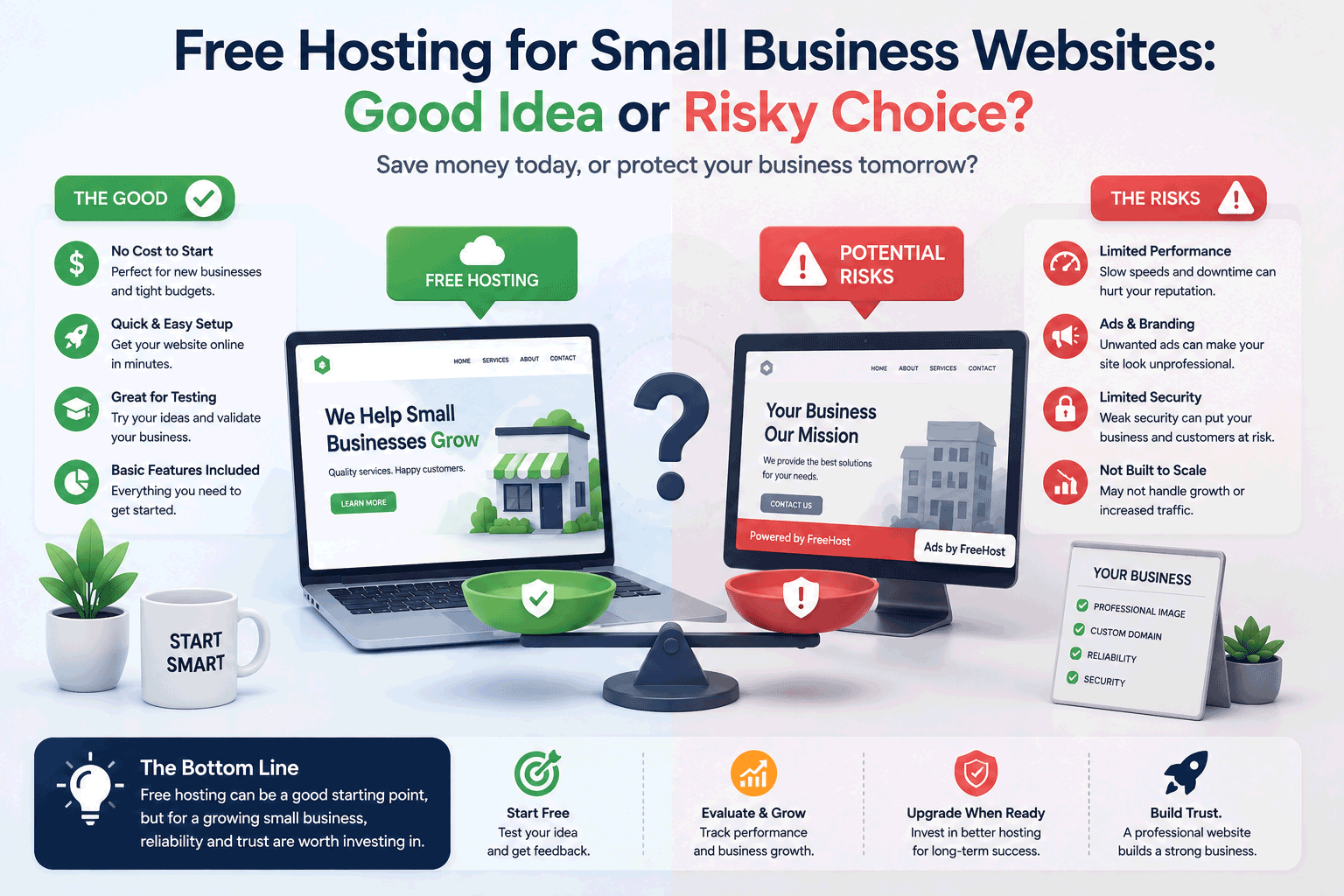
For many small business owners, building a website feels like one of those tasks that should be simple, but quickly becomes confusing.
You may only want a basic website with your business name, services, contact details, photos, opening hours, and maybe a short introduction. Then you start looking at hosting options and find free hosting, paid hosting, website builders, WordPress plans, domain names, SSL, email hosting, storage limits, and many other things that may not feel clear at first.
At that point, free hosting can look very attractive.
It sounds like an easy way to get started without adding another monthly cost. For a small business that is still testing an idea or trying to reduce expenses, this can be tempting.
But is free hosting a good idea for a small business website?
The answer is: it depends on how serious the website is, what you expect from it, and how much risk you are willing to accept.
Free hosting can be useful for some small business situations, especially in the early stage. But for a public-facing business website, it also comes with limitations that should not be ignored.
Why small businesses consider free hosting
Many small businesses do not start with a large marketing budget.
A local shop, home-based business, freelancer, service provider, small restaurant, repair service, consultant, or new online seller may simply need a basic online presence. The owner may not want to spend money on hosting before knowing whether the website will bring real value.
Free hosting can help in this early stage.
It allows a business owner to test a website idea, prepare a first draft, create a temporary page, or learn how website management works before paying for a more complete solution.
For a business that is still shaping its services, branding, or offer, free hosting can be a low-risk place to experiment.
In that sense, free hosting is not a bad idea by itself. It can be a practical starting point.
The real issue is whether it is suitable for the website your customers will actually see.
A business website is not only a website
A small business website is more than a collection of pages.
It is often part of your first impression.
When someone visits your website, they may be checking whether your business looks real, trustworthy, active, and professional. They may want to know what you offer, where you are located, how to contact you, whether your work looks reliable, and whether they should choose you over another provider.
This means your website plays a role in customer trust.
Even a simple website can support your business if it looks clean, loads properly, works on mobile, has clear contact information, and feels reliable.
On the other hand, a website that loads slowly, shows unwanted ads, uses a long free subdomain, lacks HTTPS, or looks temporary may create doubt.
Visitors may not know that the issue comes from free hosting. They will simply judge the business based on what they see.
That is why small businesses need to be more careful than students or hobby users when choosing free hosting.
When free hosting can be acceptable for a small business
Free hosting can make sense when the website is not yet your official public presence.
For example, it may be useful for:
- testing a website layout before launch
- preparing a draft version of your business site
- learning how WordPress or a website builder works
- creating a temporary page for internal review
- testing a new service idea
- building a simple proof of concept
- comparing website platforms before choosing a paid plan
In these cases, free hosting can save money and give you time to experiment.
You can test content, try different designs, check how your service pages look, and understand what kind of website you really need.
If the website is not yet being used to attract customers, the risks are lower.
Free hosting is often safe when it is used as a testing space, not as the final home for your business website.
When free hosting becomes risky
Free hosting becomes risky when your website is public and important to your business.
If customers, clients, partners, or potential buyers are visiting the site, the hosting quality matters more.
A business website may need:
- a custom domain
- HTTPS/SSL
- fast loading speed
- no forced ads
- reliable uptime
- mobile-friendly design
- working contact forms
- backup options
- basic security
- room to grow
- support when something goes wrong
Many free hosting plans may not provide all of these in a strong or flexible way.
Some may show ads. Some may limit storage or bandwidth. Some may not allow custom domains. Some may provide limited support. Some may be slow during busy periods. Some may make migration difficult when you want to move later.
For a personal test website, these limitations may be acceptable. For a business website, they can directly affect trust and customer experience.
The problem with forced ads and branding
One of the biggest concerns for small business websites is forced advertising or provider branding.
Some free hosting services place banners, popups, footer messages, or provider labels on websites. This is one way they support their free plans.
For a small business, this can be a problem.
Imagine a customer visiting your service page and seeing unrelated ads or strong platform branding. Even if your content is good, the website may feel less professional.
It may also distract visitors from your message.
A business website should keep attention on your services, products, contact details, and value to customers. Unwanted ads can weaken that focus.
If your free host shows ads, you should think carefully before using it as your official business website.
A custom domain matters for trust
A custom domain is your own website address, such as yourbusiness.com.
For a small business, a custom domain usually looks more credible than a free subdomain like yourbusiness.provider.com.
A free subdomain is not always bad. It may be fine for testing or temporary use. But if you want customers to remember your website and trust your brand, a custom domain is often better.
It also gives you more control over your online identity.
If you later move to another hosting provider, your domain can stay with you. This makes your business less dependent on one platform.
Before choosing free hosting, check whether custom domain support is included. If it is only available on a paid plan, you should decide whether upgrading is worth it.
For most serious small business websites, a custom domain is one of the first things to consider.
Website speed affects customer behavior
Speed is not only a technical issue.
It affects how visitors feel.
If your website takes too long to load, people may leave before reading your offer. This is especially true on mobile devices, where many local business searches happen.
A slow website can make a business feel less reliable, even if the business itself is excellent.
Free hosting may sometimes use shared resources with many other websites. This can affect speed and consistency, especially if the free plan has limited server resources.
If your business website only has a few visitors, this may not seem like a big issue at first. But if you plan to share the website on social media, use it in ads, print it on business cards, or send it to customers, loading speed becomes more important.
A business website should not make visitors wait too long.
Contact forms and customer inquiries must work properly
Many small business websites exist for one main reason: to help customers contact the business.
This could be through a contact form, phone number, email link, booking request, quotation form, or message button.
If your hosting platform does not handle forms well, customer inquiries may be lost or delayed.
Some free hosting plans may limit email sending, form processing, scripts, or third-party integrations. Some website builders may only allow advanced form features on paid plans.
This is important because a broken contact form can cost real opportunities.
Before using free hosting for a business site, test every contact method carefully.
Send test messages. Check whether notifications arrive. Make sure the form works on mobile. Confirm that visitors have another way to contact you if the form fails.
For a business website, contact reliability is not optional.
Email with your domain may not be included
Many small business owners want a professional email address like contact@yourbusiness.com.
This is not always included with free hosting.
Some free hosting platforms do not provide email hosting. Others only allow email forwarding. Some require a paid upgrade.
A domain-based email is not required for every small business, but it can help your brand look more professional.
If email is important to your business, check this before choosing a hosting plan.
You may need a separate email service, a paid hosting plan, or a business email provider.
Do not assume that free website hosting automatically includes professional email.
Backups are more important than beginners think
A small business website may look simple, but it still takes time to build.
You may upload images, write service descriptions, prepare pages, adjust the design, add contact forms, and connect a domain.
If something goes wrong, you do not want to lose everything.
Backups are important because websites can break. Files can be deleted. Updates can cause issues. Accounts can have problems. Mistakes can happen.
Some free hosting services do not provide automatic backups. Some only offer backups on paid plans.
If you use free hosting for a business website, make sure you understand how to back up your site. If backup options are weak or unclear, that is a warning sign.
Your business website may be small, but your time and content still have value.
Security and HTTPS should not be ignored
Today, visitors expect websites to use HTTPS.
A website without HTTPS may show browser warnings or look less trustworthy. For a business website, this can damage confidence.
Many hosting platforms now provide free SSL, but the details can vary. Some support SSL only on platform subdomains. Some support it with custom domains. Some require extra setup.
If your website has forms, collects customer inquiries, or represents your business publicly, HTTPS should be treated as a basic requirement.
Security also matters if you use WordPress or any system with login access. Weak hosting, outdated software, poor password practices, or lack of backups can create problems.
Free hosting may be fine for testing, but for a public business site, basic security should be checked carefully.
Free hosting can limit growth
A business website may start small, but it can grow.
You may begin with one homepage and later add service pages, blog posts, customer FAQs, portfolio galleries, booking features, product pages, downloadable documents, or landing pages for campaigns.
As the website grows, free hosting limits may become more noticeable.
Storage may run out. Bandwidth may become too small. The website may slow down. You may need better SEO tools, analytics, backup options, forms, or integrations.
If the free plan does not offer a smooth upgrade path, you may need to move the website elsewhere.
Migration can take time, especially if the platform is closed or does not allow easy export.
Before building a business website on free hosting, think about whether the platform can support your next step.
Free hosting can be useful for a business draft
One smart way to use free hosting is as a draft environment.
You can build a first version of your business website, test the structure, prepare content, and understand what pages you need.
For example, you might create:
- homepage draft
- about page
- services page
- portfolio page
- contact page
- FAQ page
- simple landing page
This lets you organize your ideas before investing in a final platform.
Once the content and design direction are clearer, you can move to a stronger hosting plan, connect a custom domain, and launch the website more professionally.
This approach keeps the benefit of free hosting while reducing the risk.
Free hosting for temporary business pages
Free hosting may also be useful for temporary business pages.
For example, you may need a short-term page for an event, test campaign, limited promotion, internal presentation, or early product idea.
If the page is not meant to become your main business website, free hosting may be enough.
However, even temporary pages should be checked for speed, mobile layout, HTTPS, and contact reliability if customers will see them.
Temporary does not mean careless.
Free hosting for local small businesses
Local businesses often rely on trust and convenience.
A customer may search for your business on a phone and quickly check your website for services, price range, location, opening hours, photos, or contact details.
For this type of visitor, the website does not need to be complex. But it must be clear and reliable.
If free hosting can provide a clean, fast, mobile-friendly page with no distracting ads and proper contact information, it may work at the early stage.
But if the free plan makes the site look temporary or unreliable, it may hurt more than help.
For local businesses, clarity and trust are more important than having many advanced features.
Free hosting for freelancers and solo professionals
Freelancers, consultants, designers, writers, photographers, coaches, and solo service providers may consider free hosting for personal business sites.
For this group, presentation matters a lot.
A portfolio or service website may be the first place potential clients evaluate your work. If the website looks clean and loads well, it can support your credibility. If it shows ads, looks unfinished, or uses a long free subdomain, it may reduce confidence.
Free hosting can be used to create a first draft or simple portfolio. But for serious client-facing use, a custom domain and professional setup are usually worth considering.
Your website does not need to be expensive. It just needs to look like you care about your work.
Free hosting for online stores is usually not ideal
If your small business plans to sell products online, free hosting may not be the best foundation.
An online store needs more than basic pages. It may require payment processing, security, product management, customer data handling, order notifications, inventory tools, shipping settings, and reliable uptime.
This is where free hosting can become risky.
For e-commerce, trust and stability are very important. Customers need to feel safe entering information and completing payments.
A free plan may be useful for testing a store concept or building a demo, but for real sales, a dedicated e-commerce platform or reliable paid hosting is usually a better choice.
How to decide if free hosting is right for your small business
A simple way to decide is to ask what role the website will play.
If the website is only for testing, learning, or preparing a draft, free hosting may be fine.
If the website will represent your business publicly, receive customer inquiries, support marketing, appear on business cards, or help customers decide whether to contact you, you should be more careful.
Ask yourself:
- Will customers see this website?
- Does it need to look professional?
- Do I need my own domain?
- Will ads or branding affect trust?
- Does the site need to load fast?
- Do contact forms need to work reliably?
- Do I need backups?
- Can I move the website later?
- Is this only temporary, or will it become my main website?
Your answers will show whether free hosting is enough or whether a paid option is safer.
Free hosting vs paid hosting for small business
| Area | Free Hosting | Paid Hosting |
|---|---|---|
| Cost | No hosting fee to start | Monthly or yearly cost |
| Best use | Testing, drafts, temporary pages | Public business websites |
| Domain | Often subdomain or limited custom domain support | Better custom domain support |
| Ads/branding | May include ads or provider branding | Usually no forced ads |
| Speed | Can be limited | Usually more stable |
| Support | Often limited | Better support options |
| Backups | May be limited or unavailable | More backup options |
| Often not included | More likely available or supported | |
| Trust | Depends heavily on platform | Usually more professional |
| Growth | May become limited quickly | More room to expand |
This does not mean every small business must pay immediately. But it shows why paid hosting often becomes more suitable when the website becomes part of the business.
When a low-cost paid plan may be better than free hosting
Sometimes the best choice is not expensive hosting, but a simple low-cost paid plan.
A small paid plan may give you:
- custom domain support
- no forced ads
- better performance
- more storage
- SSL support
- backups
- better support
- professional email options
- easier upgrade path
For many small businesses, this can be worth the cost.
If your website helps bring even one customer, one booking, one inquiry, or one sale, the value may be higher than the hosting fee.
The decision should not be based only on saving money. It should be based on whether the website supports your business properly.
Common mistakes small businesses make with free hosting
One mistake is treating the website as “just a small page” and ignoring customer trust.
Another mistake is launching on free hosting without checking ads, domain support, SSL, backups, or speed.
Some business owners also build too much content on a free platform before realizing migration is difficult.
Others choose a free website builder that looks easy at first, but later discover that important features require a paid upgrade.
The biggest mistake is not planning the next step.
Free hosting can help you start, but you should know what you will do if the website becomes important.
Good idea or risky choice?
Free hosting can be a good idea when it is used for the right purpose.
It is useful for testing, drafting, learning, temporary pages, early business ideas, and simple experiments.
But it can become risky when used as the main public website for a serious business, especially if it affects trust, speed, contact reliability, security, branding, or growth.
A business website does not need to be large or expensive. But it should be reliable enough for the role it plays.
If your website is only an experiment, free hosting can be helpful.
If your website is part of your business identity, free hosting should be chosen very carefully.
How FreeHostsFinder wants to help
At FreeHostsFinder, we understand that many people start small.
Not every business owner wants to pay for hosting before knowing what they need. Not every website needs a complex setup from day one.
But we also believe users should understand the trade-offs clearly.
Our goal is to help readers compare free and low-cost hosting options in a practical way. We want to explain which platforms are suitable for testing, learning, simple websites, portfolios, small business drafts, and more serious use cases.
Free hosting can be useful. But choosing the right hosting means looking beyond the word “free.”
It means understanding what your website needs, what your visitors expect, and what may happen when your business grows.
Final thoughts
Free hosting for small business websites can be both helpful and risky.
It is helpful when you are testing an idea, preparing a draft, learning how websites work, or creating a temporary page.
It becomes risky when your website needs to represent your business professionally, collect customer inquiries, support marketing, or build trust with visitors.
For small businesses, the website does not have to be complicated. But it should feel clear, trustworthy, and reliable.
Before choosing free hosting, think about your real purpose. Is this website only for testing, or will customers actually use it? Do you need a custom domain, no ads, good speed, backups, support, and a professional image?
The right choice depends on the role your website plays.
Free hosting can help you begin. But if your website is part of your business reputation, make sure the hosting supports that responsibility.
Leave a Reply
You must be logged in to post a comment.