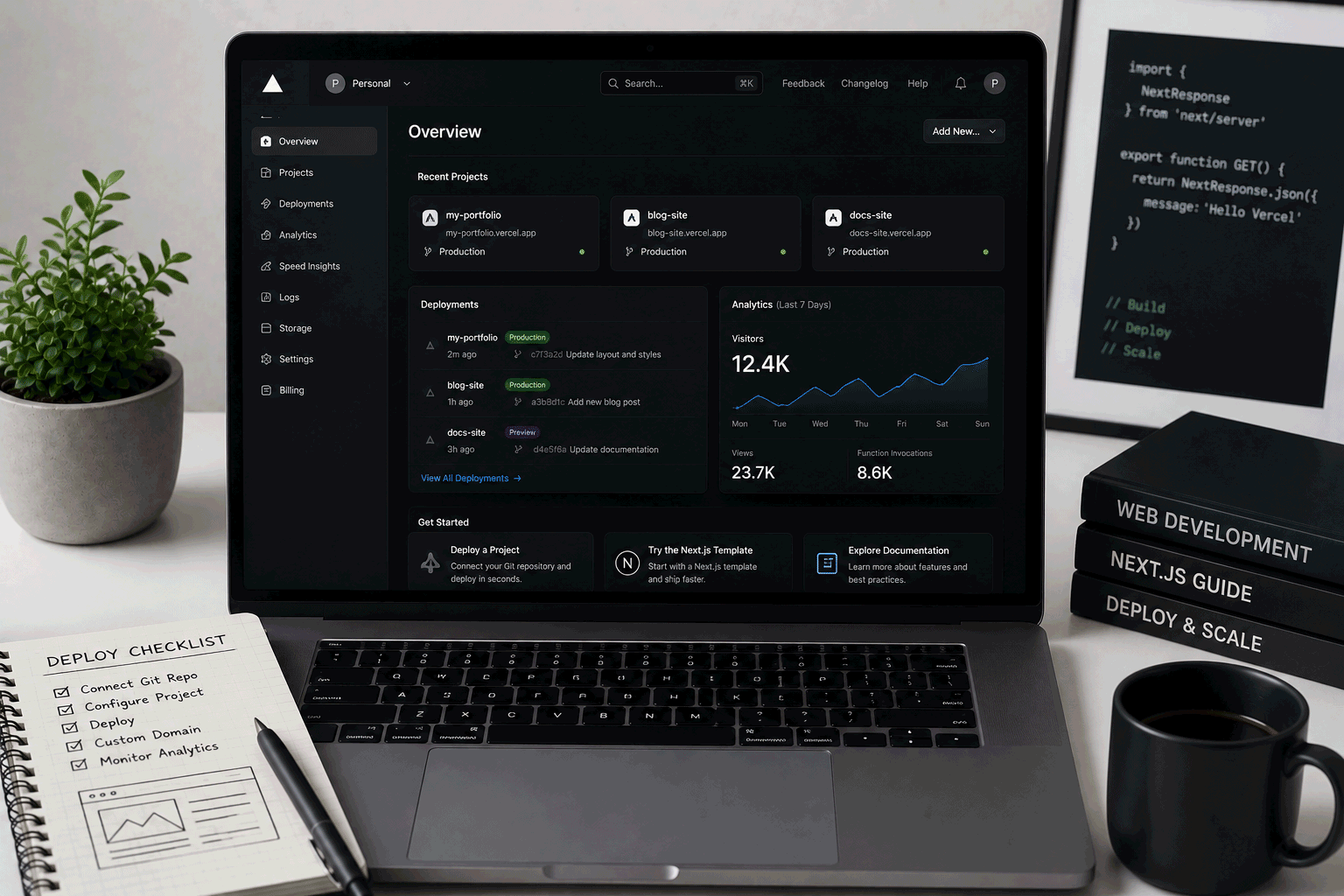
Vercel is one of the most recognizable platforms for modern frontend hosting, especially for developers building with Next.js. It is often used for frontend apps, portfolios, landing pages, documentation, personal projects, and small web applications that need a fast deployment workflow.
The main idea is simple: connect your code repository, deploy your project, and let Vercel handle the build and hosting process. For developers, this can feel much cleaner than old-style hosting with FTP uploads, control panels, and manual file management.
Vercel is not traditional free web hosting. It is not mainly designed for PHP, MySQL, cPanel, or normal self-hosted WordPress. It is better understood as a frontend and application deployment platform with strong support for modern JavaScript frameworks, functions, global delivery, automatic CI/CD, and project previews.
Vercel’s current pricing page describes the Hobby plan as free forever and suitable for web apps or personal projects. The same page lists features such as importing a repo, automatic CI/CD, a global automated CDN, Web Application Firewall, DDoS mitigation, Fluid compute, and traffic/performance insights.
Vercel can be excellent when your project fits its model. But the Hobby plan is not a blank check for every kind of website. It is best for personal, non-commercial, small-scale projects where the usage limits and terms make sense.
Link to the official Vercel website
Quick summary
| Item | Details |
|---|---|
| Provider | Vercel |
| Hosting type | Frontend hosting / web app deployment platform |
| Best for | Next.js projects, frontend apps, developer portfolios, personal web apps, demos |
| Free plan | Yes, Hobby plan |
| Free-plan positioning | Personal projects and small-scale applications |
| Git deployment | Supported |
| Automatic CI/CD | Listed on Vercel pricing page |
| CDN | Global automated CDN listed on Vercel pricing page |
| Custom domains | Supported by Vercel platform |
| Functions | Supported, with Hobby plan limits |
| Active CPU included usage | 4 CPU-hours on Hobby plan |
| Function invocations | First 1,000,000 on Hobby plan |
| Image optimization source images | First 1,000 on Hobby plan |
| Web analytics events | First 50,000 events on Hobby plan |
| Projects limit | 200 projects on Hobby plan |
| Concurrent builds | 1 on Hobby plan |
| Build time per deployment | 45 minutes |
| PHP/MySQL | Not traditional PHP/MySQL hosting |
| WordPress | Not normal self-hosted WordPress hosting |
| Best use | Personal frontend projects, Next.js demos, portfolios, app prototypes |
| Not ideal for | PHP/MySQL apps, normal WordPress hosting, ecommerce backends, business-critical free hosting |
Vercel’s Hobby plan documentation says the Hobby plan is free and aimed at developers with personal projects and small-scale applications. It lists included usage such as 4 CPU-hours, 1,000,000 function invocations, 100 GB-hours function duration, 1,000 image optimization source images, 10,000 Speed Insights data points, and 50,000 Web Analytics events.
Best for
Vercel is best for developers and technical users who want a smooth way to deploy frontend applications.
It is a good fit for:
- Next.js projects
- React applications
- Frontend app demos
- Developer portfolios
- Personal web apps
- Landing pages
- Documentation sites
- Startup MVP prototypes
- Student frontend projects
- Projects connected to Git repositories
- Lightweight apps that use functions carefully
- Users who want automatic deployments from code changes
Vercel is especially strong when your project is built around the modern frontend workflow: repository, build, deploy, preview, improve, repeat.
For a developer, that workflow is often more useful than a traditional hosting account.
Not ideal for
Vercel is not the best match for every project.
You may want another hosting type if your website needs:
- Traditional PHP hosting
- MySQL or MariaDB hosting
- cPanel-style hosting
- Normal self-hosted WordPress
- Classic shared hosting features
- Long-running backend processes
- Heavy server-side workloads on a free plan
- Large media storage
- Ecommerce backend logic
- A visual no-code website editor
- Predictable business hosting without usage-limit concerns
Vercel can run functions and modern web applications, but it is not the same thing as a traditional web host. If your project is a PHP/MySQL assignment or a standard WordPress site, Vercel is not the normal choice.
If you want a drag-and-drop website builder, Vercel may also feel too technical.
Free plan overview
Vercel’s free plan is called the Hobby plan. Vercel describes it as free and aimed at developers with personal projects and small-scale applications.
The Hobby plan includes a useful set of monthly limits, including:
- 4 CPU-hours of Active CPU
- 360 GB-hours of Provisioned Memory
- First 1,000,000 Function Invocations
- First 100 GB-hours of Function Duration
- First 1,000 Image Optimization Source Images
- First 10,000 Speed Insights Data Points
- 1 Speed Insights Project
- First 50,000 Web Analytics Events
Vercel’s limits page also lists general Hobby limits such as:
- 200 projects
- 100 deployments created per day
- 2,000 deployments created from CLI per week
- 10 Vercel projects connected per Git repository
- 2,048 routes per deployment
- 45 minutes build time per deployment
- 100 MB static file uploads
- 1 concurrent build
- 23 GB disk size
For many personal projects, this is generous. But users should still understand what happens when limits are reached. Vercel’s Hobby documentation says that because the Hobby plan is free, there are no billing cycles, and in most cases, if usage limits are exceeded, the user must wait until 30 days have passed before the feature can be used again.
That makes the plan useful for learning and personal projects, but less suitable for websites where predictable availability matters.
Key features
1. Strong fit for Next.js
Vercel is closely associated with Next.js and is often one of the first platforms developers consider for deploying Next.js projects.
This is useful if your project includes:
- static pages
- dynamic routes
- API routes
- server components
- image optimization
- frontend application logic
- preview deployments
- modern build workflows
For a Next.js learner or developer, Vercel often feels like the natural place to test and publish a project.
That does not mean every website needs Vercel. But if Next.js is your main framework, Vercel deserves attention.
2. Repository-based deployment
Vercel is built around a modern deployment workflow.
You can import a repository, deploy the project, and let Vercel rebuild the site when changes are pushed. Vercel’s pricing page highlights “import your repo, deploy in seconds” and automatic CI/CD as Hobby plan features.
This is helpful for:
- personal projects
- student apps
- frontend portfolios
- open-source demos
- client previews
- fast iteration
For developers, this workflow is usually much better than manually uploading files.
3. Global CDN and performance-focused delivery
Vercel’s pricing page lists a global automated CDN as part of its Hobby offering.
For static pages and frontend assets, a CDN can help deliver content quickly to visitors in different locations. This is especially useful for portfolios, public demos, landing pages, and documentation.
Of course, hosting is only one part of speed. Your site still needs clean code, optimized images, and careful use of scripts.
A heavy frontend app can still feel slow even on a strong hosting platform.
4. Functions for application behavior
Vercel supports functions, which allow web applications to run server-side logic without managing a traditional server.
The Hobby plan includes the first 1,000,000 function invocations and first 100 GB-hours of function duration.
This can be useful for:
- simple API routes
- form handling
- lightweight backend logic
- app prototypes
- server-rendered pages
- personal dashboard projects
- small experimental tools
Vercel Functions are powerful, but they are not unlimited. If your project depends heavily on functions, check the limits carefully.
5. Generous project limits for personal use
Vercel’s limits page lists 200 projects for the Hobby plan.
For one person learning, testing, and building personal projects, that is a lot of room.
This makes Vercel useful for:
- multiple learning projects
- frontend experiments
- portfolio versions
- small demos
- practice applications
- student work
The number of projects is not usually the first limit most users hit. Function usage, analytics, image optimization, build workflow, or commercial-use questions may matter more.
6. Useful analytics and insights for small projects
The Hobby plan includes first 50,000 Web Analytics events and first 10,000 Speed Insights data points, according to Vercel’s Hobby documentation.
For a personal project or portfolio, this can help you understand basic traffic and performance without adding too much extra setup.
For serious analytics, business reporting, or high-traffic sites, you may need a more complete analytics approach.
Important limitations to know
1. Hobby plan is best for personal and small-scale projects
Vercel’s Hobby plan is free and aimed at developers with personal projects and small-scale applications.
That wording matters.
If you are building for a client, business, ecommerce store, organization, or revenue-generating project, check Vercel’s current plan terms carefully before using the Hobby plan.
For FreeHostsFinder readers, I would position Vercel Hobby as excellent for learning, portfolios, demos, and personal apps — not as a free replacement for paid business hosting.
2. Usage limits reset differently from normal monthly billing
Vercel’s Hobby documentation says that since the Hobby plan is a free tier, there are no billing cycles. In most cases, if you exceed usage limits, you need to wait until 30 days have passed before using the feature again.
This is important because a project may not simply “keep working normally” if a limit is reached.
For low-risk personal projects, that may be acceptable. For public business sites or client work, it may not be.
3. Only one concurrent build on Hobby
Vercel’s limits page lists 1 concurrent build for Hobby, compared with 12 on Pro.
For a solo developer, this is usually fine.
But if you manage many projects, deploy often, or work with a team, build queues can become noticeable. This is one reason paid plans may make sense for serious work.
4. Static file upload limit
Vercel’s limits page lists static file uploads at 100 MB for Hobby.
This does not affect many small frontend projects, but it matters if your project includes large static assets.
For large downloads, video files, or heavy media projects, use a storage service designed for that purpose.
5. Function limits need attention
Vercel Functions are useful, but they have limits.
Vercel’s function limits documentation lists maximum memory for Hobby at 2 GB and default/maximum memory as 2 GB / 1 vCPU for Hobby. It also explains function limits around size, duration, and runtime behavior.
For lightweight app logic, this can be enough. For heavy backend tasks, long-running processes, or resource-intensive workloads, it may not be the right free platform.
6. Not suitable for traditional PHP/MySQL websites
Vercel is not a traditional shared host.
It is not the place to install PHP scripts, create MySQL databases, manage cPanel, or run normal self-hosted WordPress.
If your project requires PHP and MySQL, choose a traditional web host instead.
7. Beginners may find it technical
Vercel is simple for developers, but not necessarily simple for non-technical beginners.
You may need to understand:
- Git repositories
- framework builds
- environment variables
- project settings
- deployment logs
- domains and DNS
- functions
- routing
- usage limits
If you only want to create a simple website visually, a website builder may be easier.
Who should use Vercel?
Next.js learners and developers
Vercel is one of the strongest choices for people learning or building with Next.js.
It is especially useful if you want to deploy quickly, test app features, use functions, and understand modern frontend deployment.
Frontend developers
If you build with React, Next.js, or other frontend tools, Vercel can provide a clean deployment workflow.
It is useful for projects that need builds, previews, routing, and application-style behavior.
Portfolio owners with technical skills
A developer portfolio can work very well on Vercel.
You can connect your code repository, publish updates quickly, use a custom domain, and show projects in a professional way.
Students building frontend apps
Students learning frontend development can use Vercel to publish projects, demos, and assignments.
It is especially useful for JavaScript and framework-based projects.
If the assignment requires PHP or MySQL, Vercel is not the right normal choice.
Builders testing early app ideas
If you are testing a small app idea or MVP, Vercel can be a useful starting point.
Just remember that the Hobby plan is best for personal and small-scale use. If the app becomes serious, review the upgrade path.
Who should avoid Vercel?
Users who need PHP and MySQL
Vercel is not traditional PHP/MySQL hosting.
If your project is a PHP assignment, WordPress site, Laravel project, or MySQL database application, choose another hosting type.
Users who want normal self-hosted WordPress
Vercel is not the standard place to install WordPress.
Advanced headless or static workflows may be possible, but beginners who want WordPress should choose WordPress hosting instead.
Non-technical users who want visual editing
If you want a drag-and-drop website builder, Vercel is probably not the easiest choice.
Vercel is more comfortable for people who work with code.
Business owners looking for free commercial hosting
Be careful using the Hobby plan for business purposes.
Because Vercel positions Hobby for personal projects and small-scale applications, business and client work should be checked against current terms and may be better suited to Pro or another business-friendly hosting setup.
Users with heavy backend workloads
Vercel can support serverless-style app behavior, but it is not a general-purpose backend server.
If your project needs long-running processes, heavy computation, persistent server state, or complex backend services, review the platform limits carefully.
Vercel for portfolios
Vercel is a very good option for technical portfolios, especially portfolios built with Next.js or React.
A portfolio on Vercel can include:
- personal introduction
- project pages
- case studies
- GitHub links
- resume link
- contact section
- blog or notes
- custom domain
- performance insights
For developers, hosting a portfolio on Vercel can also show familiarity with modern deployment workflows.
For non-technical portfolio owners, a no-code website builder may be easier. Vercel is best when you are comfortable working with code.
Vercel for student projects
Vercel is useful for student projects that are frontend-focused.
It works well for:
- React projects
- Next.js projects
- JavaScript apps
- frontend demos
- static websites
- landing pages
- personal portfolio assignments
- app prototypes
Students should avoid choosing Vercel for assignments that require traditional PHP, MySQL, or WordPress.
The project stack should decide the hosting choice.
Vercel for Next.js projects
This is where Vercel is strongest.
If your project uses Next.js, Vercel usually provides a smooth path from repository to deployment. It supports the type of application workflow many Next.js developers expect, including builds, routing, functions, and previews.
For learning, this can be very helpful because you can move from local development to a live URL quickly.
For production or business use, check usage, terms, and pricing carefully.
Vercel for business websites
Vercel can be used for business websites, but the free Hobby plan should be treated carefully.
A simple static or frontend business site may technically deploy well, but business use may require a paid plan depending on the project, usage, and Vercel’s current terms.
Before using Vercel for a business site, review:
- plan eligibility
- expected traffic
- function usage
- image optimization needs
- analytics usage
- support requirements
- custom domain setup
- upgrade cost
- what happens when limits are reached
For a business-critical site, a paid plan or a different hosting model may be safer.
Free plan vs paid upgrade
Vercel’s Hobby plan is useful for personal, non-commercial, small-scale projects. It gives developers a free way to deploy and test modern frontend projects.
Use the Hobby plan if:
- your project is personal
- you are learning
- you are building a portfolio
- you are testing a frontend idea
- traffic is low or moderate
- usage limits are acceptable
- you do not need team/business support
Consider upgrading or choosing another platform if:
- the site is commercial
- the project is for a client
- the site is business-critical
- you need more included usage
- you need faster builds or fewer queues
- you need team collaboration
- you need better spend management
- you want more predictable production support
Vercel’s pricing page lists Pro at $20/month plus additional usage and says Pro includes $20 of included usage credit, advanced spend management, team collaboration, faster builds with no queues, and cold start prevention.
The free plan is a strong starting point. Paid plans make more sense when the project moves from personal experiment to serious web application.
Final opinion
Vercel is one of the best-known platforms for modern frontend deployment, and it is especially strong for Next.js projects, personal web apps, frontend demos, and technical portfolios.
Its value is not just that it has a free plan. Its value is that it gives developers a clean workflow: import a repository, deploy quickly, use modern framework features, and keep improving the project through automatic deployments.
The Hobby plan is generous for personal projects, with included usage for functions, CPU, image optimization, analytics, and more. But it should be used with the right expectations. Vercel positions Hobby as free and aimed at developers with personal projects and small-scale applications, and usage limits can restrict features until 30 days have passed if they are exceeded.
Use Vercel when your project is frontend-focused, especially if it uses Next.js or a similar modern workflow. Avoid it if you need PHP/MySQL, normal WordPress hosting, no-code visual editing, or a free plan for business-critical hosting.
For the right developer, Vercel is a very strong free starting point. For the wrong project, it is the wrong kind of hosting.
Link to the official Vercel website
FAQ
Is Vercel free?
Yes. Vercel offers a free Hobby plan. Vercel describes it as free and aimed at developers with personal projects and small-scale applications.
What is Vercel best for?
Vercel is best for frontend applications, Next.js projects, developer portfolios, personal web apps, static sites, landing pages, and modern JavaScript projects.
Is Vercel good for Next.js?
Yes. Vercel is one of the strongest choices for deploying Next.js projects, especially for developers who want a smooth workflow from repository to deployment.
Can Vercel host WordPress?
Not in the normal self-hosted WordPress way. WordPress usually needs PHP and a database, while Vercel is designed for frontend and application deployment workflows.
Can Vercel run PHP and MySQL?
No, not as traditional PHP/MySQL hosting. If your project needs PHP, MySQL, cPanel, or normal shared hosting features, choose a traditional web host.
What are Vercel Hobby plan limits?
Vercel’s Hobby plan includes limits such as 4 CPU-hours, 360 GB-hours provisioned memory, first 1,000,000 function invocations, first 100 GB-hours function duration, first 1,000 image optimization source images, first 10,000 Speed Insights data points, and first 50,000 Web Analytics events.
What happens if I exceed Hobby plan limits?
Vercel says that because the Hobby plan is a free tier, there are no billing cycles, and in most cases, if usage limits are exceeded, the user must wait until 30 days have passed before using the feature again.
Is Vercel good for portfolio websites?
Yes, especially for developer portfolios built with Next.js, React, or other frontend tools. It is less suitable for non-technical users who want visual drag-and-drop editing.
Is Vercel good for student projects?
Yes, if the student project is frontend-focused or built with frameworks such as Next.js or React. It is not the right normal choice for PHP/MySQL assignments.
Should I use Vercel for a business website?
Vercel can host business websites on appropriate plans, but the free Hobby plan should be used carefully. For commercial or business-critical use, review Vercel’s current plan terms and consider Pro or another suitable hosting option.
“Vercel is strongest when your project is built like a modern frontend app — not when you need old-style shared hosting.”
Leave a Reply
You must be logged in to post a comment.