Starting a website today is much easier than it used to be. You no longer need to be a technical expert, buy a server, or understand every detail of web hosting before publishing something online.
At the same time, the number of choices can feel overwhelming.
There are free hosting providers, low-cost hosting plans, website builders, WordPress platforms, static hosting services, cloud tools, and now even AI website builders. For a beginner, it can be hard to know where to start.
One of the most common questions is still very simple:
Is free web hosting still worth it?
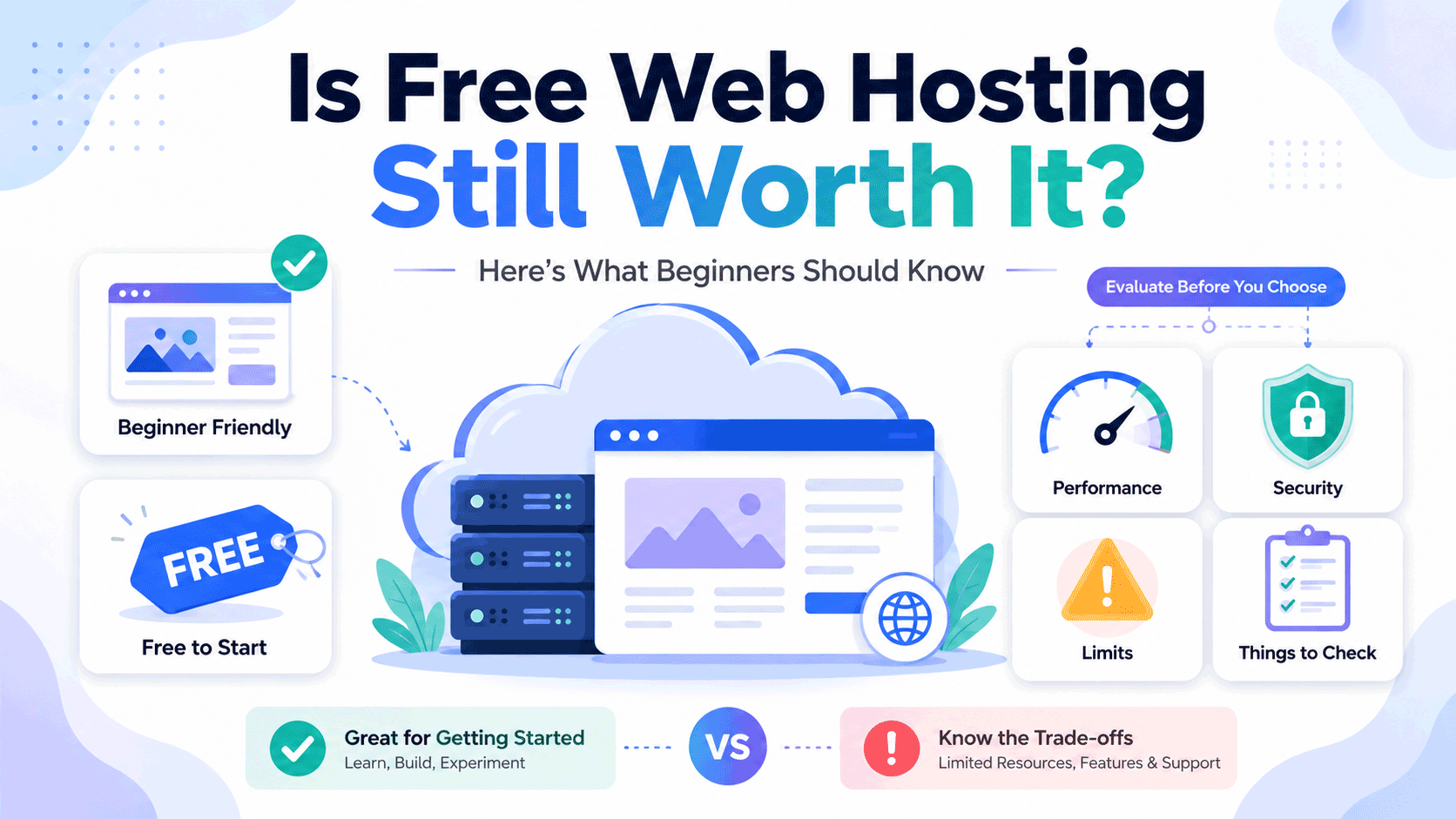
The answer is: yes, but only when you understand what it is good for — and what its limits are.
Free web hosting can be a great starting point, especially if you are learning, testing, or building something small. But it is not always the right choice for every website. Before you spend your time creating pages, uploading files, or setting up a project, it is worth knowing what free hosting can really offer.
Free web hosting is still useful for beginners
Free web hosting remains useful because it gives people a simple way to begin without financial pressure.
If you are building your first website, you may not want to pay for hosting immediately. You may still be learning what a domain name is, how website files work, what WordPress needs, or how to connect a website to the internet.
In that stage, free hosting can be helpful.
It gives you a place to experiment. You can test ideas, try a basic design, upload a few pages, install a simple application, or understand how hosting works before moving to a paid plan.
For many beginners, the first goal is not perfection. The first goal is simply to get something online and learn from the process.
That is where free hosting can still have real value.
When free hosting makes sense
Free hosting can be a good option when your project is small, temporary, or experimental.
For example, it may be suitable for a student project, a personal learning website, a coding practice site, a simple portfolio draft, a test WordPress installation, or a basic landing page for an idea that is not ready for full investment yet.
It can also be useful if you want to compare platforms before choosing where to build seriously.
Instead of paying first and regretting later, you can use a free option to understand the workflow, control panel, website builder, performance, and limitations of a provider.
In this way, free hosting works best as a starting point, not always as the final destination.
When free hosting may not be enough
Free hosting may not be the best choice if your website is important for business, revenue, clients, or long-term growth.
A business website needs reliability. An online store needs security, speed, support, and stable performance. A professional portfolio may need a custom domain and no unwanted ads. A content website may need better storage, backups, and room to grow.
Free hosting plans often come with restrictions. These restrictions are not always a problem, but they can become frustrating if your project becomes more serious.
You may face limited storage, limited bandwidth, slower loading speeds, no email hosting, limited database support, fewer security options, or reduced customer support. Some providers may place ads on your website. Some may not allow a custom domain on the free plan. Others may make it difficult to migrate your site later.
That is why beginners should not only ask, “Is it free?”
A better question is:
“Is this free hosting suitable for what I want to build?”
The word “free” can hide important trade-offs
Free hosting is not automatically bad. Many free platforms are useful and honest about what they provide.
But “free” usually comes with trade-offs.
The provider still needs to pay for servers, storage, bandwidth, support, and maintenance. Because of that, a free plan may be limited by design. It may be supported by ads, upgrade paths, branding, usage restrictions, or reduced features.
This is normal. The important thing is whether those trade-offs are clear and acceptable for your project.
For example, ads may be acceptable on a temporary test site, but not on a client-facing business website. Limited storage may be fine for a small HTML site, but not for a media-heavy blog. A subdomain may be enough for practice, but not ideal for a brand that wants to build trust.
The issue is not that free hosting has limits. The issue is when users do not notice those limits until after they have already invested time in building the website.
Beginners should check the basics first
Before choosing a free web hosting provider, it is useful to check the basic features carefully.
Start with the type of website you want to create. Do you need WordPress? Do you need PHP and MySQL? Are you building a static HTML website? Do you want a drag-and-drop website builder? Do you need Git deployment? The best hosting option depends heavily on the type of website you plan to build.
Then check the practical limits. Look at storage, bandwidth, file size limits, database availability, SSL support, custom domain support, backups, ads, support options, and upgrade pricing.
Also pay attention to migration. If your website grows, can you move it easily? Can you export your files, database, or content? Can you connect your own domain now or later?
A free hosting plan is much safer to use when you know how easy it will be to move forward.
Free hosting is not one single category anymore
In the past, free web hosting mostly meant a basic hosting account with limited space and a control panel.
Today, the picture is much wider.
Some free hosting services are designed for traditional websites. Some are better for WordPress. Some are ideal for static websites. Some are focused on developers. Some are website builders where you do not need to manage hosting directly. Some are connected with cloud platforms, serverless tools, or AI-assisted website creation.
This is good news for users, but it also makes comparison more important.
A platform that is excellent for a static portfolio may not be suitable for a WordPress blog. A website builder may be perfect for a beginner who wants speed and simplicity, but not ideal for someone who wants full control over code and hosting settings.
There is no single “best free hosting” for everyone.
There is only the best fit for your current purpose.
A simple way to think about free hosting
For beginners, it may help to think of free hosting in three levels.
The first level is learning. You are practicing, exploring, and trying to understand how websites work. In this stage, free hosting is often a very good choice.
The second level is testing. You have an idea, but you are not ready to invest yet. You want to create a sample website, demo page, prototype, or early version. Free hosting can also work well here.
The third level is growing. Your website now matters. People visit it. It represents your brand, business, content, or service. At this stage, free hosting may still work in some cases, but you should be much more careful. A paid plan or more reliable platform may become the better option.
This does not mean beginners should avoid free hosting. It simply means they should use it with the right expectations.
So, is free web hosting still worth it?
Yes, free web hosting is still worth it for many beginners.
It is worth it when you want to learn.
It is worth it when you want to test.
It is worth it when your project is small.
It is worth it when you understand the limitations.
It is worth it when you have a plan to upgrade or move later if needed.
But free hosting may not be worth it when you need strong reliability, professional branding, high performance, full support, or long-term business use from the beginning.
The value of free hosting depends on the purpose of your website.
Used correctly, it can be a helpful first step. Used without checking, it can become a limitation that slows you down later.
Final thoughts
Free web hosting still has an important place on today’s internet.
It helps beginners start. It gives students and developers room to practice. It allows creators, small projects, and early ideas to go online without upfront cost. It can be a useful bridge between having an idea and building something real.
But free hosting should be chosen with care.
Before you build, take a little time to understand what the provider offers, what it limits, and whether it matches your website goal.
At FreeHostsFinder, our aim is to make that process easier. We want to help readers compare free and low-cost hosting options more clearly, understand the trade-offs, and choose a platform that fits their real needs.
Free hosting can still be worth it.
The key is knowing when it works, when it does not, and what to check before you begin.
Leave a Reply
You must be logged in to post a comment.