Free hosting is often the first step for many people who want to build something online.
It may be a personal website, a student project, a small portfolio, a test blog, a landing page, or a simple idea that is not ready for a paid hosting plan yet. For these situations, free hosting can be very helpful. It gives people a place to start, experiment, and learn without worrying about monthly costs.
But there is one important thing beginners should understand early:
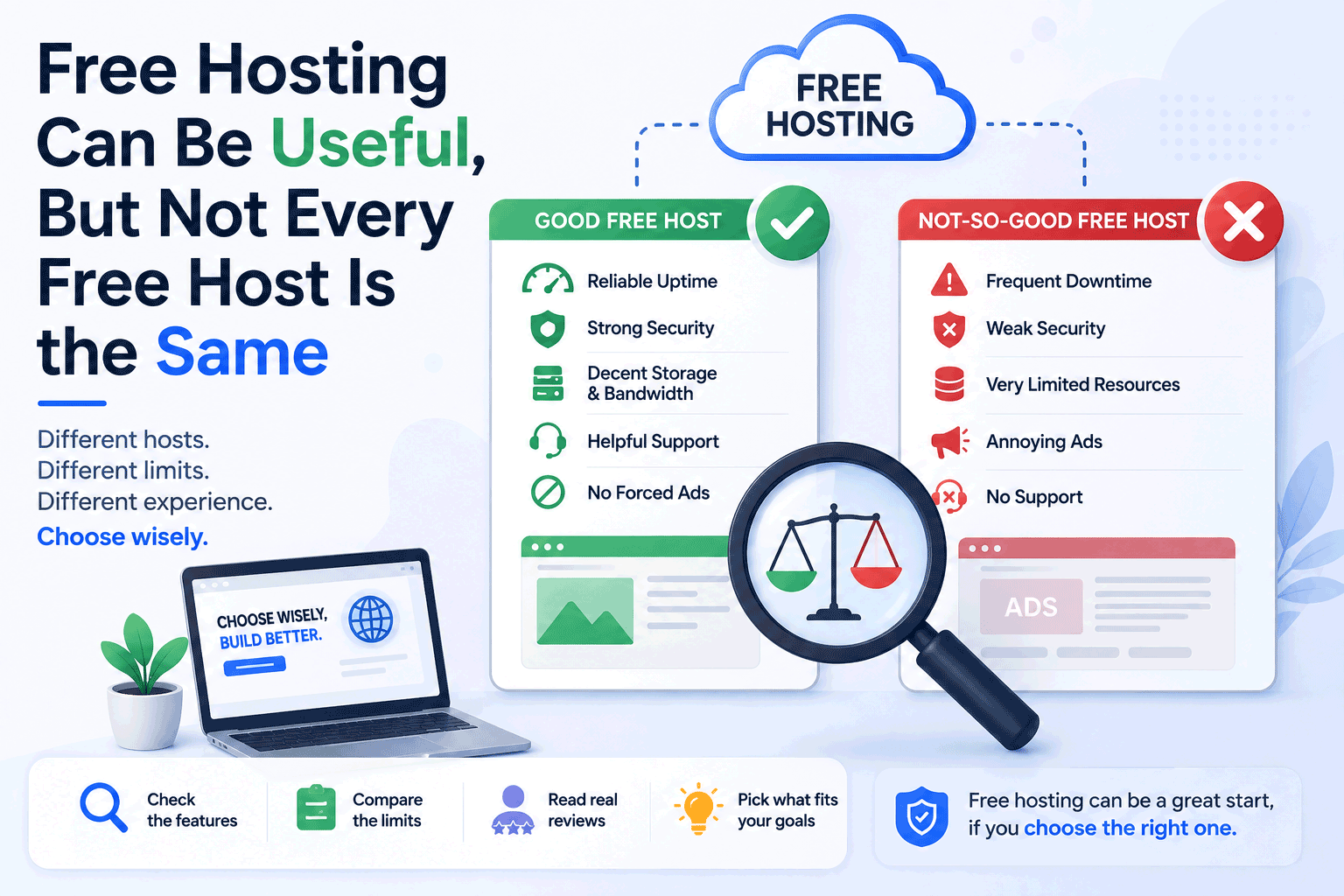
Not every free hosting service is the same.
Some free hosting platforms are designed for learning. Some are made for static websites. Some are focused on WordPress. Some are better for developers. Some are simple website builders. Some are useful for short-term testing, while others may become too limited very quickly.
That is why choosing free hosting should not only be about finding a “free” plan. It should be about finding the right kind of free hosting for what you want to build.
Free hosting is not one single thing anymore
In the past, free hosting usually meant a basic web hosting account with limited storage, a small amount of bandwidth, and maybe a simple control panel.
Today, the meaning is much wider.
A free hosting option could be a traditional web hosting plan. It could be a free WordPress hosting platform. It could be static hosting for HTML, CSS, and JavaScript websites. It could be a no-code website builder. It could be a developer platform connected to Git. It could even be part of a larger cloud or AI-assisted website creation tool.
This gives users more choices, which is good.
But it also creates more confusion.
A platform that is great for one type of website may not be suitable for another. A free static hosting service may be excellent for a portfolio, but not useful if you need WordPress. A free website builder may be easy for beginners, but limited if you want full control over your code. A traditional free hosting account may support PHP and databases, but may have stricter limits on speed, storage, or support.
So instead of asking only, “Which free hosting is best?”, it is better to ask:
“Which free hosting is best for this specific purpose?”
The right free host depends on what you are building
Before choosing a free host, you should first understand your website goal.
A student who wants to submit a simple HTML project does not need the same hosting setup as someone who wants to test WordPress. A designer building a portfolio may need clean presentation and a custom domain. A developer may care more about Git deployment, build tools, and version control. A small business owner may need reliability, contact forms, and a professional appearance.
Each purpose has different needs.
For example, if you only need a simple personal page, a static hosting platform may be enough. If you want to practice WordPress, you need hosting that supports WordPress properly. If you want to test PHP and MySQL, you need a host that allows database access. If you want to build quickly without technical setup, a website builder may be easier.
Free hosting becomes more useful when it matches your real project, not just your budget.
Some free hosts are good for learning
Free hosting can be excellent for learning.
If you are new to websites, free hosting gives you a safe place to make mistakes. You can upload files, connect pages, install tools, test designs, and understand how a website works without paying upfront.
For beginners, this is valuable.
Learning web hosting from articles alone can feel abstract. But once you actually upload a page, connect a domain, enable SSL, or try to fix a broken layout, things become more real. Free hosting can help turn theory into practice.
However, a learning-focused host does not need to be perfect. It only needs to give you enough space to practice.
That is why some free hosts are very useful for beginners, even if they are not ideal for serious business websites.
Some free hosts are better for short-term testing
Another good use of free hosting is testing.
Maybe you have an idea for a small website, but you are not sure whether it is worth investing in yet. Maybe you want to test a landing page, try a new layout, or compare different platforms. Maybe you want to build a demo before deciding whether to buy a domain and paid hosting.
In this case, free hosting can reduce risk.
You can build something small, check how it feels, and decide later whether to continue. If the project becomes more serious, you can upgrade or move to a better hosting environment.
But if the host makes migration difficult, the free plan may become a trap. This is why it is always worth checking whether you can export your files, database, or content before building too much on any free platform.
Some free hosts may look attractive but feel limited later
Many free hosting plans look good at first glance.
They may offer free storage, free website creation, free subdomains, free SSL, or easy publishing. These features are useful, but they are not the full story.
The real question is what happens after you start using the service.
Can your website load fast enough? Can you connect a custom domain? Are there ads on your pages? Is there enough storage for your content? Can you use the tools you need? Is there a database? Are backups included? Can you contact support if something goes wrong? Can you move your website later?
These details may not feel urgent at the beginning, but they can become important quickly.
A free host may be acceptable for a small practice site, but not suitable for a project that represents your name, brand, business, or long-term work.
Free does not always mean no cost
Free hosting may not cost money, but it can still have a cost in other ways.
The cost may be limited control.
The cost may be ads on your website.
The cost may be slower performance.
The cost may be less support.
The cost may be time spent moving your website later.
The cost may be a less professional impression if your site uses a long subdomain or forced branding.
This does not mean free hosting is bad. It simply means users should understand the trade-off.
Every hosting provider needs resources to run servers, maintain systems, provide support, and handle traffic. If a service is free, the provider usually balances that by limiting features, showing ads, encouraging upgrades, or offering free plans as an entry point to paid services.
That is normal.
What matters is whether the trade-off is acceptable for your website.
A free host can be good, but only for the right stage
Free hosting works best when it is used at the right stage.
For the beginning stage, it can be very helpful. You can learn, test, and publish without pressure. You can explore different tools and understand what kind of website you really want to build.
For the growth stage, you may need to be more careful. If more visitors are coming, if the website supports a business, or if your content is becoming important, then speed, reliability, support, backups, and ownership become much more important.
For the professional stage, free hosting may not always be enough. A business website, client project, online store, or long-term content platform usually needs a more stable environment.
That does not make free hosting useless. It simply means free hosting has a role.
It is often a starting point, not always the final home.
How to compare free hosting more carefully
When comparing free hosting providers, try not to look only at the biggest numbers.
A plan with more storage is not always better if the platform is slow or difficult to use. A free website builder is not always better if you cannot move your content later. A host with many features is not always better if important features are locked behind upgrades.
Instead, compare based on your actual needs.
Ask yourself:
- What type of website am I building?
- Do I need WordPress, static hosting, PHP, MySQL, or a website builder?
- Do I need a custom domain?
- Will ads appear on my website?
- Is SSL included?
- Are storage and bandwidth enough for my project?
- Can I back up or export my website?
- Can I upgrade smoothly if the project grows?
- Is the platform suitable for beginners, developers, or business users?
These questions can help you avoid choosing a host that looks good at first but does not fit your real purpose.
Not every user needs the same answer
One of the most common problems with hosting recommendations is that they try to give one answer to everyone.
But a beginner, a student, a blogger, a developer, and a small business owner may all need different things.
A beginner may need simplicity.
A student may need something free and quick.
A developer may need Git deployment and flexible tools.
A blogger may need WordPress support.
A business owner may need reliability and a professional setup.
A creator may need an easy way to publish a portfolio.
This is why “best free hosting” should always depend on the situation.
A good free host is not the one with the longest feature list. It is the one that fits your current goal and does not block your next step.
How FreeHostsFinder wants to help
FreeHostsFinder is being rebuilt with this practical view in mind.
We do not want to treat all free hosting platforms as if they are the same. We want to help readers understand the differences between hosting types, platform limits, use cases, and upgrade paths.
Our goal is to make free and low-cost hosting easier to understand for real users, especially beginners who may not know what to check yet.
That means looking beyond the word “free” and asking more useful questions:
Who is this platform good for?
What kind of website does it support?
What are the limits?
What should users be careful about?
When should they consider upgrading?
Is it suitable for learning, testing, personal use, development, or business?
These are the kinds of questions that can help users make better decisions.
Final thoughts
Free hosting can be useful. It can help people start faster, learn safely, test ideas, and publish small projects without upfront cost.
But not every free host is the same.
Some are good for beginners. Some are better for developers. Some are suitable for static websites. Some are designed for WordPress. Some are useful for quick testing, while others may be too limited for long-term use.
The best choice depends on what you want to build and how far you expect the website to go.
Before choosing a free host, take a little time to understand the platform, its limits, and its purpose. A careful decision at the beginning can save you time, frustration, and unnecessary migration later.
At FreeHostsFinder, we hope to make that decision easier by sharing clear guides, practical comparisons, and honest notes that help you choose free hosting with more confidence.
Leave a Reply
You must be logged in to post a comment.